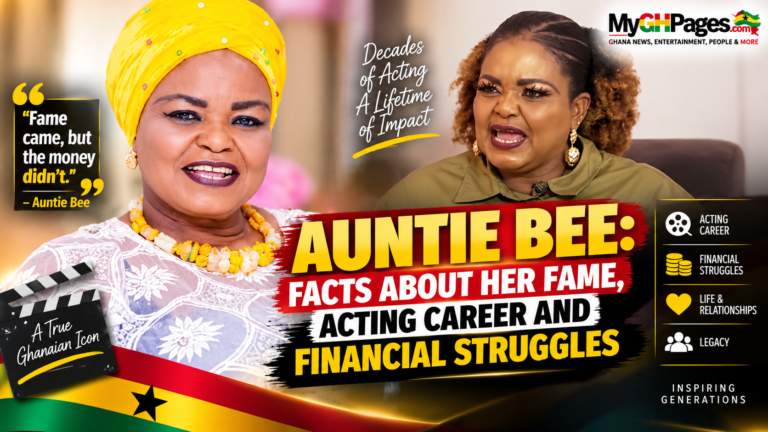
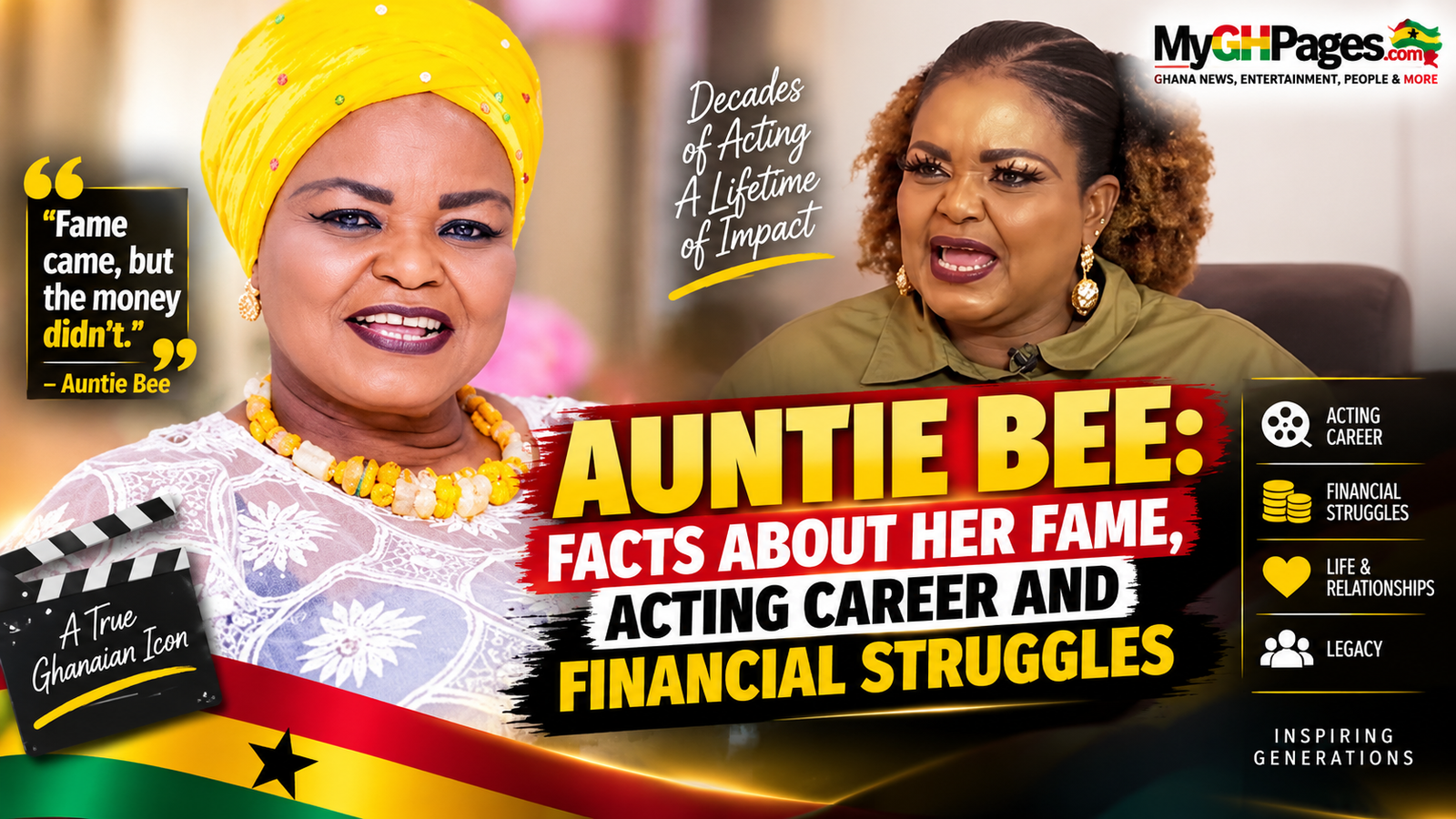
Auntie Bee, veteran Ghanaian actress known for Efiewura and Key Soap Concert Party
What Did the Industry Give Auntie Bee? The Untold Financial Story of Ghana’s Veteran Actress
For generations of Ghanaian viewers, Auntie Bee has been far more than a familiar face on television. She is one of the veteran entertainers whose career stretches across some of the most important stages in Ghana’s entertainment history, from travelling theatre and Concert Party performances to television and local film.
Known in real life as Harriet Naa Akleh Okanteh, Auntie Bee became widely recognised through productions including Key Soap Concert Party and the popular television series Efiewura. Her career has also been closely associated with the late Ghanaian comedian Bob Santo, with whom she said she had a six-year relationship. (Wikipedia)
But behind the laughter, recognition and decades of entertainment lies a question that deserves serious attention:
What did the entertainment industry actually give Auntie Bee in return for the years she spent entertaining Ghanaian audiences?
Her own comments provide a sobering answer.
In a 2024 interview, Auntie Bee said that despite spending decades in acting, she could largely boast of fame rather than significant financial wealth. She explained that her passion for acting began in childhood and that she did not develop another trade or profession alongside entertainment. (Pulse Ghana)
Her story raises wider questions about financial security, income management, retirement planning, property ownership, investment, business opportunities and wealth creation in Ghana’s entertainment industry.
It is a story about fame and money, but it is also a story about an entire generation of entertainers whose contribution to Ghanaian culture was enormous even when their financial rewards were limited.
Auntie Bee Before the Fame
In a 2024 interview, Auntie Bee spoke about the financial challenges she experienced during her long acting career and the sacrifices she made for entertainment.
Auntie Bee’s journey did not begin with modern television studios, social media or streaming platforms.
Like many entertainers of her generation, she came through live performance.
According to her own account, she started with Key Soap Concert Party, a comic theatre production that toured different parts of Ghana and was also shown on television. The travelling nature of the work meant performers moved from town to town entertaining audiences. (Pulse Ghana)
This was a very different entertainment economy from what exists today.
There were no YouTube monetisation programmes, Spotify royalties, influencer campaigns or sophisticated digital advertising systems providing multiple potential revenue streams.
An actor’s earning opportunities were largely connected to performances, television appearances, film productions and whatever commercial arrangements producers offered.
Concert parties were nevertheless hugely important to Ghanaian popular culture.
It brought comedy directly to communities and helped create performers who later became familiar television and movie personalities.
Auntie Bee was part of that tradition.
She was not simply entering a profession.
She was joining a cultural institution that had already become part of Ghanaian entertainment.
From Concert Party to Efiewura
Auntie Bee later became widely recognised through Efiewura, a Ghanaian television series that helped establish her as one of the country’s familiar female comedy personalities.
Her television career allowed audiences who might never have attended a live Concert Party performance to experience her acting from their homes.
That was a major transition.
Television dramatically expanded the reach of Ghanaian entertainers.
A performer who previously appeared before audiences in particular towns could suddenly become recognised across the country.
Auntie Bee became one of those recognisable personalities.
Her comic performances and distinctive personality helped make her memorable.
The importance of Efiewura to her career is also reflected in descriptions of her professional background, with sources identifying the series and Key Soap Concert Party among the productions for which she is known. (Wikipedia)
For readers interested in Ghanaian entertainment and celebrity stories, you can explore more coverage through MyGHPages Showbiz and entertainment coverage.
Fame Does Not Always Mean Financial Security
This is where Auntie Bee’s story becomes particularly important.
Celebrity culture can create the impression that anyone who becomes famous must automatically become wealthy.
But fame and financial security are not the same thing.
An entertainer can be recognised by millions of people without owning substantial property.
An actor can appear in numerous productions without having a stable retirement fund.
A television personality can become a household name without having sufficient savings or investment income.
Auntie Bee’s comments illustrate that contradiction.
In a 2024 interview, she said she had gained fame from acting but had not achieved the level of financial prosperity many people might assume comes with a long entertainment career. She also said she had not learnt another trade because of her commitment to acting. (Pulse Ghana)
That admission deserves to be viewed within the context of the entertainment business at the time.
The industry has changed substantially.
Today’s entertainers can potentially combine acting with social media marketing, brand partnerships, YouTube revenue, event appearances, merchandise, digital subscriptions, streaming, personal businesses and property investment.
Earlier generations did not necessarily have the same opportunities.
The Financial Reality of Concert Parties
Auntie Bee’s description of Concert Party provides an important insight into the economics of traditional entertainment.
She explained that performers travelled to different towns and villages, sometimes staying away for extended periods because of their work.
That lifestyle created expenses and made saving difficult.
She recalled that performers could travel to a location for work, encounter economic difficulties while there and return home with little or nothing. (Pulse Ghana)
This is a significant point.
A job can provide income without creating wealth.
If an entertainer receives money from a performance but spends much of it on transportation, accommodation, food, family responsibilities and other expenses, the income may disappear without creating long-term financial security.
That distinction between income and wealth is one that many young entertainers can learn from today.
Income pays for today’s needs.
Wealth creation requires planning for tomorrow.
That can involve savings, investment, property acquisition, business ownership, retirement planning and developing additional sources of income.
Auntie Bee’s story shows what can happen when an entire career is built around one profession without sufficient financial diversification.
When the Industry Became More Lucrative
Auntie Bee has also reflected on how the entertainment industry changed over time.
According to her comments, theatre initially provided opportunities but not necessarily substantial financial rewards. Later, film became more lucrative, but she observed that some people who accumulated wealth and property had other advantages or moved quickly through relationships with producers. (Class FM Online)
This is an important historical observation.
The growth of Ghana’s film industry created new commercial opportunities.
Movies became increasingly popular.
Television exposure expanded.
Local-language productions attracted large audiences.
But industry growth did not necessarily mean that every participant benefited equally.
Some performers became major stars.
Others remained working actors without accumulating significant assets.
That difference between industry growth and individual financial outcomes remains relevant today.
Why Property Ownership Matters
One of the most striking parts of Auntie Bee’s comments concerns property.
Reports about her 2024 interview noted that she said she did not have substantial property or financial achievements to show for her long career. (GhHeadlines)
Property is particularly important in Ghana because land and housing are often viewed as long-term forms of wealth.
For an entertainer, buying land or building a home can provide financial security after active entertainment work slows down.
It can also provide an asset that may appreciate over time.
This is why conversations about real estate investment in Ghana, retirement planning and financial literacy are increasingly relevant to creative professionals.
The entertainment industry can be unpredictable.
A performer may be extremely popular at one point and receive fewer bookings later.
A television series may end.
A film market may change.
Audience preferences may shift.
New actors may become more popular.
Digital technology may completely transform how content is produced and distributed.
Property and other investments can therefore provide an important financial cushion.
Readers interested in Ghana’s property market can also explore MyGHPages’ wider Ghana news and business coverage for related stories about business, investment and economic developments.
Auntie Bee Chose Acting Because She Loved It
Financial success was not necessarily the only motivation behind Auntie Bee’s career.
She has spoken openly about her passion for acting.
According to an interview reported by Pulse Ghana, she said she had loved acting and film from childhood and did not learn another trade because she was deeply committed to the profession. (Pulse Ghana)
That passion matters.
Artists frequently enter entertainment because they love performance.
They want to make people laugh.
They want to tell stories.
They want to appear on stage.
They want to connect with audiences.
Money may not be the first motivation.
But eventually, the economic realities of life become unavoidable.
Food costs money.
Housing costs money.
Healthcare costs money.
Education costs money.
Transportation costs money.
Retirement also costs money.
That is why passion and financial planning need to work together.
The Bob Santo Connection
Auntie Bee’s career is also closely connected with the late Ghanaian comedian Bob Santo, whose real name was John Evans Kwadwo Bosompem.
She has spoken publicly about their relationship, saying they dated for six years.
Her relationship with Santo was connected to the period when they worked within Ghana’s entertainment and performance industry. (ghanaplus.com)
Bob Santo remains one of the names associated with Ghanaian comedy history.
His death in 2002 marked the loss of one of the country’s recognised comic performers.
Auntie Bee has continued to speak about him years later, helping preserve memories of their professional and personal connection.
Their story also reminds audiences of how closely connected personal relationships and professional networks could be within the entertainment industry.
The End of an Era
Auntie Bee belongs to a generation that experienced several major transitions.
She moved from live theatre to television and later became associated with Ghana’s film and comedy culture.
That means her career effectively provides a window into the evolution of Ghanaian entertainment.
She witnessed the period when live concert party performances were central to popular entertainment.
She experienced the expansion of television.
She saw the growth of local-language film.
She watched Ghanaian comedy become a major component of popular culture.
And she has lived through the arrival of digital entertainment.
That is an extraordinary professional journey.
Nearly four decades in entertainment represents more than just a long career.
It represents cultural continuity.
What Modern Entertainment Can Learn From Her Story
The biggest lesson from Auntie Bee’s story may not be about acting.
It may be about financial planning.
Today’s entertainers have more opportunities to diversify their income than many performers had in earlier generations.
An actor can potentially build a personal brand online.
They can work with businesses through advertising and sponsorship.
They can produce YouTube content.
They can appear at events.
They can create digital products.
They can establish businesses.
They can invest in property.
They can save through regulated financial institutions.
They can explore insurance and retirement planning.
They can build businesses outside entertainment.
The modern entertainment economy is increasingly connected to the digital economy.
That creates opportunities that were difficult to imagine during the height of Concert Party.
But opportunities are only valuable when they are managed properly.
The Business of Celebrity
Celebrity itself has become an economic asset.
An entertainer with a large audience can potentially attract advertising campaigns.
Brands may pay for visibility.
Events may pay for appearances.
Digital platforms can provide monetisation opportunities.
Companies can use celebrities for marketing campaigns.
This means today’s entertainer is not simply a performer.
The entertainer is also potentially a brand.
That makes financial literacy even more important.
An actor should understand contracts, taxes, licensing, intellectual property, sponsorship agreements, personal branding and investment.
The entertainment industry may provide the initial platform.
Business and financial management can determine whether that success becomes long-term wealth.
Auntie Bee’s experience demonstrates why that distinction matters.
Fame, Income and Wealth Are Three Different Things
These three concepts are often confused.
Fame means people know you.
Income means you receive money.
Wealth means you have accumulated assets and financial resources that can support you over time.
A person can have fame without high income.
A person can have a high income without wealth.
And someone can have relatively modest public visibility while possessing substantial wealth.
Auntie Bee’s story is particularly powerful because her public recognition appears to have been much greater than the financial benefits she says she received from acting.
She entertained audiences for decades.
Yet she has spoken about wanting greater financial security.
That contradiction deserves attention.
The Value of Creative Work
There is also another question hidden inside Auntie Bee’s story:
How should society value creative work?
Actors make people laugh.
They tell stories.
They preserve culture.
They create characters that become part of national memory.
They help television programmes succeed.
They contribute to Ghana’s cultural identity.
Yet creative workers can sometimes struggle financially.
This is not unique to Ghana.
Across the world, entertainment professionals have faced questions about fair compensation, royalties, contracts and long-term financial security.
For Ghana, these conversations are particularly important as the creative economy expands.
Ghana’s Entertainment Industry Is Changing Again
The current entertainment environment is dramatically different from the one Auntie Bee entered.
A young actor today can create a TikTok video and reach hundreds of thousands of people.
A YouTube programme can attract viewers outside Ghana.
A Ghanaian movie can be distributed digitally.
An artist can receive international attention through streaming platforms.
Social media has reduced some traditional barriers between entertainers and audiences.
But the new economy also creates new challenges.
Competition is intense.
Attention is difficult to maintain.
Advertising revenue can fluctuate.
Platform algorithms can change.
Digital content can become popular without necessarily producing stable income.
So while today’s entertainers have more opportunities, they also need more sophisticated business and financial strategies.
Auntie Bee’s Legacy Is Bigger Than Money
Despite her comments about financial difficulties, it would be wrong to measure Auntie Bee’s entire career only by her bank balance.
Her contribution to Ghanaian entertainment has cultural value.
She helped entertain generations.
She participated in a concert party.
She became associated with Efiewura.
She helped preserve a style of Ghanaian comedy that remains familiar to many viewers.
Her work became part of people’s childhood and family memories.
Those things have value even when they cannot be measured in cedis.
The challenge is ensuring that future entertainers can create the same cultural impact while also achieving sustainable financial security.
Why Ghana Should Remember Its Veteran Entertainers
Ghana’s entertainment history contains many performers whose names deserve documentation.
Some are remembered because of famous movies.
Others because of television.
Some became known for comedy.
Others became associated with music or theatre.
Auntie Bee belongs to that group of veteran entertainers whose careers span multiple generations.
Her story should therefore be preserved not only as celebrity news but also as part of Ghana’s cultural history.
For more stories about Ghanaian musicians, actors and entertainers, readers can visit MyGHPages and follow its continuing entertainment coverage.
The Importance of Financial Education for Entertainers
If there is one practical lesson from Auntie Bee’s experience, it is that creative talent should be accompanied by financial education.
Young performers should understand how to budget.
They should understand the importance of emergency savings.
They should consider appropriate insurance.
They should understand investment risk.
They should think about property ownership when financially possible.
They should develop additional skills.
They should understand the commercial value of their intellectual property.
They should learn how contracts work.
And they should think about retirement long before retirement arrives.
These issues may sound less glamorous than red carpets and television appearances, but they can determine the quality of life an entertainer enjoys after the spotlight becomes less intense.
From Celebrity to Sustainable Career
A sustainable entertainment career should ideally have several dimensions.
There is the creative side.
There is the professional side.
There is the commercial side.
And there is the financial side.
A performer can be talented and famous while still struggling economically if these areas are not connected.
Auntie Bee’s career shows what can happen when passion dominates and financial planning receives less attention.
Her honesty can therefore become a lesson for the next generation.
Young entertainers should not be ashamed to talk about money.
They should understand their market value.
They should ask questions about contracts.
They should protect their earnings.
They should invest where appropriate.
They should build businesses where possible.
And they should remember that popularity can change.
What Did the Industry Give Auntie Bee?
So, what did the industry give Auntie Bee?
It gave her a platform.
It gave her a career.
It gave her recognition.
It gave her opportunities to travel.
It gave her relationships with other performers.
It gave her television exposure.
It gave her the opportunity to entertain millions.
It gave her a place in Ghanaian cultural history.
But according to her own reflections, it did not give her the level of financial security, property ownership or long-term wealth that many people might expect from such a lengthy career. (Pulse Ghana)
And that is the bittersweet part of her story.
The industry gave her fame.
The audience gave her love.
Her performances gave Ghanaian families laughter.
But fame itself could not guarantee financial independence.
What Did Auntie Bee Give Ghana?
The better question may therefore be:
What did Auntie Bee give Ghana?
She gave Ghana laughter.
She gave audiences memorable characters.
She contributed to the Concert Party.
She became part of Efiewura.
She helped entertain generations of viewers.
She participated in a period when Ghanaian television and local entertainment were developing rapidly.
And she became part of the cultural memories of people who grew up watching Ghanaian comedy.
That contribution is difficult to put a monetary value on.
A Legacy That Money Cannot Buy
There are entertainers who leave behind enormous financial estates.
There are others who leave behind businesses, houses and investments.
And then there are entertainers who leave behind something less tangible but equally powerful: memories.
Auntie Bee belongs to the latter category in the story she has publicly told about her career.
People remember her.
People remember her performances.
People remember Efiewura.
People remember Concert Party.
People remember the generation of comedians and actors who transformed Ghanaian television.
That is a form of wealth that cannot be measured in a bank statement.
The Next Generation Should Build Both Fame and Wealth
Auntie Bee’s experience should not discourage young people from entering entertainment.
Instead, it should encourage them to enter with their eyes open.
Talent is important.
Hard work is important.
Networking is important.
But financial literacy is important too.
The modern entertainment industry offers opportunities to earn through advertising, sponsorships, streaming, content creation, brand partnerships, events and other commercial channels.
The key is learning how to turn attention into sustainable income and income into long-term financial security.
That is one of the biggest lessons hidden inside Auntie Bee’s story.
Final Reflection
Auntie Bee is more than a veteran actress.
She represents an era.
She represents the Concert Party tradition.
She represents the evolution of Ghanaian television.
She represents the generation that helped make local entertainment a household experience.
And her story exposes one of the uncomfortable realities of the entertainment business: being famous does not automatically mean being financially secure.
Her own reflections about her decades in acting have opened an important conversation about income, property, investment, retirement planning and the economic realities facing creative professionals in Ghana. (Pulse Ghana)
For almost four decades, she gave audiences entertainment.
She gave people laughter.
She created memories.
She became part of Ghana’s television history.
Today, the entertainment industry is changing again. Digital media, streaming, online advertising and social platforms are creating new opportunities for performers. The next generation has the chance to learn from the experiences of veterans like Auntie Bee and build careers that combine creative success with financial security.
Her legacy should therefore not be remembered only through nostalgia.
It should also inspire a conversation about how Ghana values its entertainers, how creative workers are compensated and how performers can protect their financial future.
Because when the cameras stop rolling, the bills do not stop.
When the television series ends, life continues.
And when fame becomes quieter, financial security becomes even more important.
Auntie Bee may not have accumulated the wealth that many people assume accompanies celebrity status, but she accumulated something that money cannot easily purchase.
She became part of the memories of Ghana.
She made generations laugh.
She helped carry Ghanaian entertainment through an important era.
And for that contribution, she deserves recognition, respect and appreciation.
The industry may not have made Auntie Bee rich in the way many expected. But through her work, she became rich in memories — and those memories remain part of Ghana’s entertainment history. 🌹🎬
FAQ
Who is Auntie Bee?
Auntie Bee is the popular name of Ghanaian actress Harriet Naa Akleh Okanteh, known particularly for Efiewura and Key Soap Concert Party.
What is Auntie Bee famous for?
Auntie Bee is best known for her work in Ghanaian theatre and television, particularly her association with Key Soap Concert Party and the popular television series Efiewura.
How long has Auntie Bee been acting?
Auntie Bee has described herself as having spent close to 40 years on stage and screen.
What did Auntie Bee say about her finances?
Auntie Bee said in a 2024 interview that her long acting career brought her significant recognition but limited financial rewards. She also discussed the difficulty of saving during the Concert Party period.
Did Auntie Bee work with Bob Santo?
Yes. Auntie Bee has publicly discussed her relationship with the late Ghanaian comedian Bob Santo, saying they were together for six years.
What was the Key Soap Concert Party?
Key Soap Concert Party was a travelling comic theatre production that performed in towns and villages across Ghana and was also shown on television. Auntie Bee has described it as an important part of the beginning of her acting career.
What is Efiewura?
Efiewura is a Ghanaian television series associated with Auntie Bee’s career and helped make her a familiar face among Ghanaian television audiences.
What financial lesson can entertainers learn from Auntie Bee?
Her story highlights the importance of financial planning, savings, investment, property ownership, retirement planning and developing multiple income streams alongside a creative career.
Did Auntie Bee make money from acting?
Auntie Bee has said that she earned some money from acting but that she did not achieve the level of financial security or property ownership that she expected after decades in the industry.
What is Auntie Bee’s legacy?
Auntie Bee’s legacy is closely connected to Ghana’s Concert Party tradition, television comedy and the development of local entertainment. Her performances remain familiar to audiences who grew up watching Ghanaian television and comedy.
FAQ
Who is Auntie Bee?
Auntie Bee, whose name is Harriet Naa Akleh Okanteh, is a Ghanaian actress known for Efiewura and Key Soap Concert Party.
What is Auntie Bee famous for?
She is particularly known for her work in Efiewura and the Key Soap Concert Party tradition in Ghanaian entertainment.
What did Auntie Bee say about her acting career?
Auntie Bee said her long acting career brought her significant public recognition but comparatively little financial reward.
How long has Auntie Bee been acting?
In her 2024 interview, Auntie Bee described having close to four decades of experience on stage and screen.
Did Auntie Bee discuss financial struggles?
Yes. She publicly discussed the difficulty of building financial security through acting during the period when she was most active in the industry.
What was the Key Soap Concert Party?
Key Soap Concert Party was a popular Ghanaian live entertainment tradition associated with touring performances and several Ghanaian entertainers, including Auntie Bee.
Was Auntie Bee connected to Bob Santo?
Yes. Auntie Bee has spoken publicly about a six-year relationship with the late comic actor Bob Santo.
What financial lesson can entertainers learn from Auntie Bee’s story?
Her comments highlight the importance of developing additional skills, building savings and considering long-term financial planning alongside an entertainment career.
What is Auntie Bee’s legacy?
Her career is associated with Ghanaian television, stage entertainment and the country’s older generation of local movie and comedy performers.