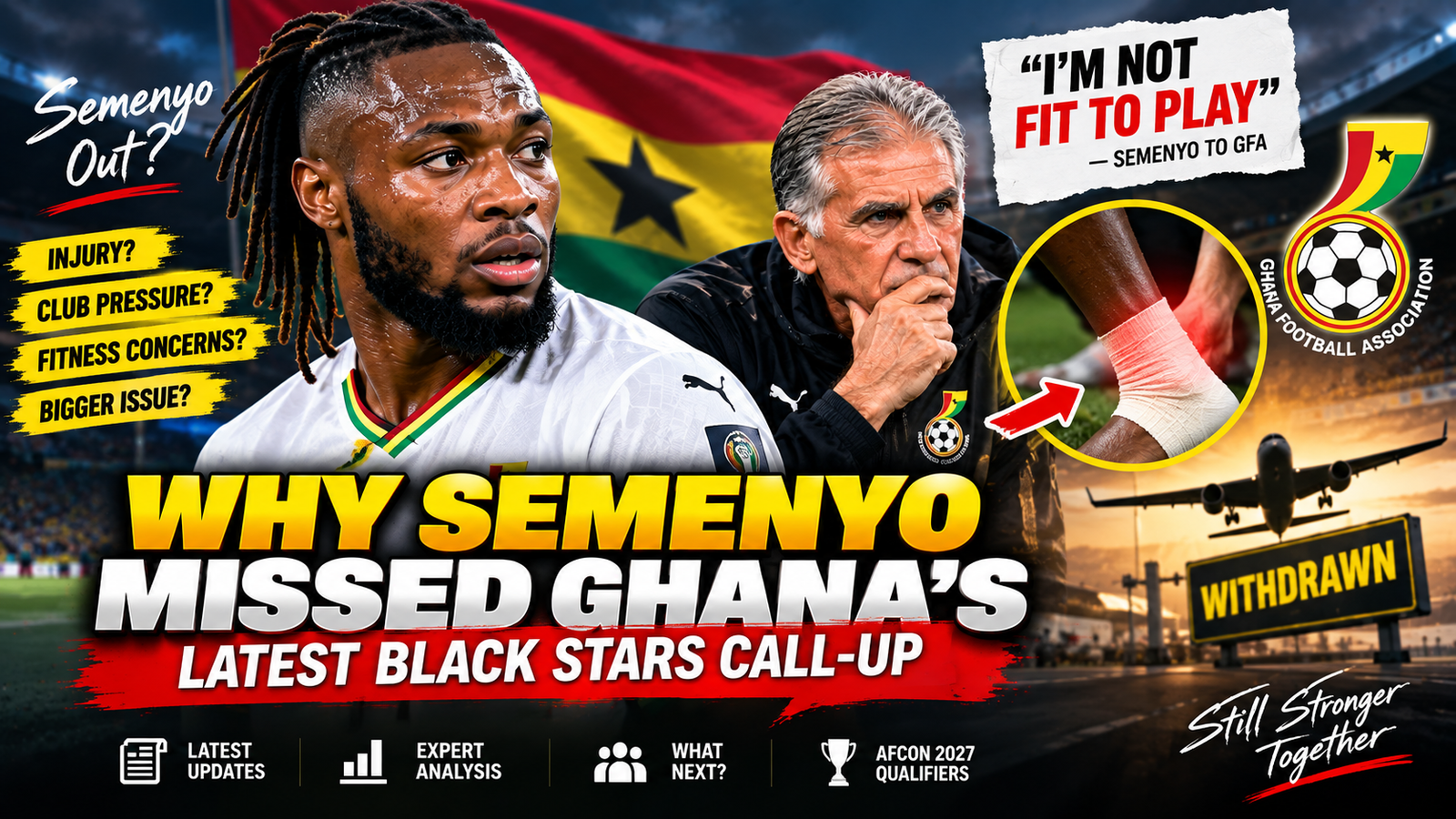
Antoine Semenyo withdrawal from the Black Stars squad explained.
What Antoine Semenyo Told the GFA About His Black Stars Withdrawal
Antoine Semenyo’s withdrawal has become a major talking point for Ghanaian football fans after the forward was ruled out of the Black Stars’ latest international assignment. Semenyo informed the Ghana Football Association (GFA) that he was unable to play because of an injury, raising questions about his fitness and when he could return to the national team.
“Antoine Semenyo’s withdrawal has created another selection headache for Ghana as the Black Stars prepare for their upcoming international fixtures.”
This puts “Antoine Semenyo withdrawal” right at the beginning of your content and should fix that SEO warning.
According to reporting by MyJoyOnline and 3Sports, Semenyo is dealing with an ankle/foot problem and was prepared to undergo an independent assessment through the Ghana Football Association (GFA) if required. That detail is significant because it indicates that the issue was presented to the national team as a medical matter rather than simply an unexplained decision to miss international duty. (MyJoyOnline)
The timing has nevertheless attracted attention. Semenyo had been enjoying an impressive start to the 2026/27 season and had recently produced an influential performance for Manchester City. His withdrawal therefore comes at a moment when Ghana is preparing for two competitive AFCON qualifiers against Côte d’Ivoire and The Gambia.
The situation has also added to a growing list of Black Stars withdrawals, with Mohammed Kudus and other players unavailable for the upcoming fixtures.
For Ghana supporters following the latest Ghana football news, the central question is no longer simply why Semenyo is missing. It is what he communicated to the GFA, how the association responded, and what his absence means for Carlos Queiroz’s plans.
Semenyo Reportedly Told the GFA He Was Injured
The key information surrounding the withdrawal is that Semenyo reportedly informed the GFA that he was unable to play because of an injury.
Michael Oti Adjei, a veteran Ghanaian sports journalist, reported that he had knowledge of conversations between the player and the association. According to the account carried by GhanaWeb and echoed by other Ghanaian sports reports, Semenyo communicated that he was dealing with a foot problem and would not be able to feature in the upcoming matches. “The Antoine Semenyo withdrawal was linked to his current fitness concerns, with reports indicating that the forward was dealing with an ankle problem.”
That explanation matters because Semenyo had recently appeared for Manchester City, prompting questions from some supporters about why a player who had just featured for his club could subsequently be unavailable for Ghana.
However, appearing in a club match does not necessarily mean a player is medically cleared for another series of competitive matches several days later.
A footballer can play while managing an injury, experience swelling after a match, or require further medical assessment before taking part in additional fixtures.
Current reporting from 3Sports describes Semenyo’s problem as a swollen ankle, while MyJoyOnline reports that he asked to be excused as he focuses on recovering from a niggling ankle injury. (3News)
Why His Recent Manchester City Appearance Raised Questions
The timing of Semenyo’s withdrawal is one of the reasons the story has attracted so much attention.
The Ghana international had been performing strongly for Manchester City and was expected to join the Black Stars for the international break.
Recent reports indicate that he had scored two goals and provided three assists in his early Premier League appearances for City. Pulse Ghana also reported that he scored twice and provided an assist in City’s 5-3 Premier League victory over Sunderland on September 20. (Pulse Ghana)
That performance naturally increased expectations surrounding his involvement with Ghana.
Supporters saw an in-form attacking player preparing to join the national team, only for news of his withdrawal to emerge shortly afterward.
But football injuries can change quickly.
A player can complete a match and subsequently experience swelling or discomfort that affects his ability to train or compete again within days.
That is why the reported offer by Semenyo to undergo an independent GFA assessment is an important part of the story.
Semenyo Was Reportedly Willing to Be Assessed
One of the most notable details in the reports is that Semenyo was reportedly willing to travel to Ghana and make himself available for assessment by the GFA medical team.
According to the account attributed to Michael Oti Adjei, Semenyo was prepared to submit himself to an independent assessment so that the association could verify the condition rather than simply relying on the player’s explanation.
This is an important distinction.
The situation could have generated more uncertainty if the player had simply declined the call-up without offering any opportunity for the national team to examine the injury.
Instead, the reported willingness to undergo assessment suggests that the medical question was taken seriously.
The GFA ultimately accepted the request for him to be excused from the international window.
The latest reporting from MyJoyOnline similarly states that Semenyo was prepared to undergo independent checks through the GFA. (MyJoyOnline)
What the GFA’s Response Tells Us
The GFA’s response is also important.
Rather than publicly accusing Semenyo of refusing national-team duty, the available reports indicate that the association accepted his request to focus on his recovery.
That approach is consistent with the fact that injury management is a normal part of professional football.
The GFA has previously dealt with Semenyo’s injuries during international windows.
In November 2025, the association announced that Semenyo had returned to his club after suffering a left anterior talo-fibula ligament sprain that was aggravated during Ghana’s match against Japan. The association said the injury had been assessed by the club and Black Stars medical teams. (Ghana Football Association)
That earlier episode provides useful context.
It demonstrates that Semenyo has previously left a Ghana camp because of a documented injury, meaning his latest withdrawal is not the first occasion on which his national-team involvement has been affected by fitness concerns.
The Current Injury Is Being Reported as an Ankle Problem
Different reports have used slightly different descriptions of the current problem.
MyJoyOnline described it as a niggling ankle injury, while 3Sports reported that Semenyo had a swollen ankle. Prime News Ghana also reported that the player had suffered ankle swelling and required further recovery and medical assessment. (MyJoyOnline)
The exact severity and recovery timeline should therefore be treated cautiously unless the GFA, Manchester City or the player’s medical representatives provide further information.
It would be premature to assume that the injury is either minor or severe without a confirmed medical assessment.
For a player operating at the highest level of professional football, even relatively small physical problems can affect sprinting, acceleration, changes of direction and match readiness.
Those qualities are particularly important for Semenyo’s style of play.
Why Semenyo’s Absence Matters to Ghana
Semenyo’s withdrawal is significant because of the role he has developed within Ghana’s attack.
The forward has become an important option for the Black Stars because of his physical strength, direct running and ability to attack space.
His absence leaves Carlos Queiroz with fewer established attacking options for the opening qualifier against Côte d’Ivoire.
Mohammed Kudus is also unavailable as he continues his recovery from a lengthy injury lay-off. Reports indicate that Kudus’ withdrawal was connected to protecting his recovery after his return to competitive football. (Pulse Ghana)
Losing two important attacking players around the same international window means the coaching staff must make further tactical adjustments.
The situation also creates opportunities for other players.
Carlos Queiroz Must Find New Attacking Solutions
Queiroz originally selected Semenyo as part of his plans for the September international window.
With the forward unavailable, the coach must consider alternative combinations.
Ernest Nuamah, Abdul Fatawu Issahaku, Ibrahim Osman and Jordan Ayew are among the attacking players who can contribute, while additional forwards have also been called into the squad.
The Ghana Football Association has added several players following medical uncertainties among members of the original squad.
That includes Brandon Thomas-Asante, Mohammed Fuseini, Benjamin Tetteh and Felix Afena-Gyan in attack. (Pulse Ghana)
The new players will have to adapt quickly because the opening qualifier is close.
International football provides little preparation time compared with club football.
A player joining a national team camp late may have only a handful of training sessions to understand his role.
The Situation Does Not Automatically Mean Club Pressure
The Semenyo case has also prompted questions about whether clubs are influencing players’ international availability.
That question is understandable given the number of Ghanaian players unavailable during the same window.
However, the available reporting does not establish that Manchester City instructed Semenyo to withdraw from Ghana duty.
The reported explanation is that Semenyo informed the GFA about his injury and requested permission to focus on recovery. He was also reportedly willing to undergo an independent assessment by the GFA medical team. (MyJoyOnline)
That is different from evidence of a club blocking a player from international duty.
Without a documented statement from Manchester City or the GFA saying otherwise, it would be speculative to present club pressure as the confirmed explanation.
The Timing Has Made the Story More Complicated
The timing remains one of the main reasons supporters are discussing the withdrawal.
Semenyo had been in strong club form, and Ghana needed attacking quality for the opening AFCON qualifier.
The Black Stars will face Côte d’Ivoire in Bouaké on September 24 before hosting The Gambia in Accra on September 29. They are also scheduled to face Morocco in a friendly on October 4. (Adomonline.com)
That means Ghana enters the international window with several matches to prepare for and limited time to establish new combinations.
The absence of a key attacker therefore has both a tactical and squad-management impact.
Semenyo’s Recent Form Made His Withdrawal More Significant
“Ghana’s coaching staff must now manage the impact of the Antoine Semenyo withdrawal while assessing the attacking options available for the upcoming matches.” Another reason the withdrawal has attracted attention is Semenyo’s recent club form.
He has established himself as an important attacking option at Manchester City and has been involved in goals during the opening stages of the season.
Pulse Ghana reported that he had scored twice and provided an assist in City’s victory over Sunderland shortly before the international break. (Pulse Ghana)
From Ghana’s perspective, having an in-form forward available would have provided another attacking option for Queiroz.
Instead, the coach must now work with the players who remain fit.
This is one of the realities of international football: club form can change quickly, while international coaches must adapt to medical developments and player availability.
Ghana’s Injury List Has Become a Wider Issue
Semenyo’s withdrawal cannot be considered in isolation.
Ghana has experienced several other player-availability problems during the same international window.
Mohammed Kudus, Nathaniel Adjei and other players have been affected by injuries or recovery concerns, while additional players have been brought into the squad. (Pulse Ghana)
This has placed greater emphasis on squad depth.
Queiroz must now determine which players can step into roles that would normally be occupied by established internationals.
That could lead to tactical changes in midfield, attack and defensive organisation.
The GFA Has Experience Managing Semenyo’s Injuries
The current situation also needs to be considered against the GFA’s previous medical reports involving Semenyo.
In 2024, the GFA reported that Semenyo was dealing with a patellar tendon injury associated with an overload of games. The association said his club medical team considered the international break an opportunity for specialist assessment to prevent the problem from worsening. (Ghana Football Association)
In 2025, another injury forced him to leave the Black Stars camp.
These previous examples demonstrate why medical management is an important part of Semenyo’s international career.
They also show why the fact that a player has recently played a club match does not necessarily settle questions about his availability for the national team.
The Player’s Long-Term Fitness Is Also Important
From a professional football perspective, recovery management is important for both the club and the country.
Semenyo has a long season ahead of him.
Manchester City will have domestic fixtures and other competitions to navigate, while Ghana has the 2027 AFCON qualifying campaign.
A recurring ankle problem could become more serious if the player returns too quickly.
That is why a medical assessment can be more useful than simply looking at whether a player completed his previous match.
The precise recovery timeline should become clearer after further medical evaluation.
Ghana Still Has Major Fixtures Ahead
The immediate concern is the opening AFCON qualifier against Côte d’Ivoire.
The match is scheduled for September 24 in Bouaké.
Ghana will then host The Gambia before facing Morocco in a friendly.
The compressed schedule means Queiroz has to prepare for different opponents while also managing the physical condition of his players.
The absence of Semenyo therefore affects more than one fixture.
It changes the options available to the coach across the entire international window.
The New Call-Ups Could Benefit From the Situation
Although Semenyo’s absence is a setback for Ghana’s original plans, it also gives other players an opportunity.
Brandon Thomas-Asante, Mohammed Fuseini, Benjamin Tetteh and Felix Afena-Gyan have all been added to strengthen the squad.
For these players, the situation provides an opportunity to demonstrate that they can contribute at a senior international level.
A strong performance could potentially lead to greater involvement in future Ghana squads.
This is one of the ways national-team injuries can change the competitive landscape.
The Black Stars Need Attacking Depth
The current situation highlights the importance of having multiple attacking options.
Ghana cannot rely permanently on Semenyo, Kudus or any other individual player.
International tournaments and qualifying campaigns are long, and injuries, suspensions and club commitments can all affect availability.
Developing depth allows the coaching staff to maintain tactical flexibility.
The current call-ups are therefore important not only for the next two qualifiers but also for identifying players who could become part of Ghana’s longer-term plans.
Semenyo’s Withdrawal Should Be Viewed Through the Available Evidence
There is a natural temptation to connect multiple player withdrawals and search for one explanation.
But the evidence currently available points to different circumstances.
Semenyo’s withdrawal has been reported as an injury-related decision, with the player reportedly communicating his condition to the GFA and being willing to undergo an independent medical assessment. (MyJoyOnline)
Kudus’ situation has been linked to recovery management following a long injury lay-off.
Other players have their own medical circumstances.
The available evidence therefore does not establish that all of the withdrawals have the same cause.
Why Transparency Matters
For supporters, transparency is important whenever an important player withdraws from national-team duty.
When a player has recently played for his club and then becomes unavailable for Ghana, questions are naturally likely to follow.
Clear communication from the player, club and association can help reduce uncertainty.
In Semenyo’s case, the reported willingness to undergo a GFA assessment is relevant because it provides a mechanism for verifying the injury.
Further medical information would help clarify the severity and expected recovery period, but that information should come from appropriate medical or official sources.
What Semenyo’s Absence Means for Queiroz
For Queiroz, the immediate task is tactical.
He must decide how to replace the qualities Semenyo brings to the attack.
That could involve using a different wide player, changing the striker profile or adjusting how Ghana progresses the ball.
Semenyo’s pace and physical presence give Ghana a particular attacking option.
Without him, the team may need to create chances differently.
That is where the new squad additions and established players become important.
Ghana’s Qualification Campaign Starts Under Pressure
The 2027 AFCON qualification campaign is particularly important for Ghana after the country’s absence from the previous edition of the tournament.
The Black Stars therefore need to manage the opening fixtures carefully.
Facing Côte d’Ivoire away provides an immediate challenge, while the home match against The Gambia gives Ghana another competitive fixture only days later.
Semenyo’s absence adds to the preparation challenge.
The coaching team will need to focus on the players who are available rather than spending too much time on those who cannot participate.
Supporters Will Continue to Watch the Situation
Semenyo’s recovery will remain a subject of interest during the international break.
Ghana supporters will want to know how long the injury is expected to keep him out, whether he returns to Manchester City training and whether he will be available for upcoming Premier League fixtures.
For the national team, the longer-term concern is whether he will be fully fit for future AFCON qualifiers.
The answer will depend on the severity of the injury and his recovery process.
The Bigger Picture for Antoine Semenyo
Semenyo has become an increasingly important Ghana international.
The GFA has previously documented his development with the national team, including his international goals and his ambitions to perform on the world stage. In an earlier interview published by the association, Semenyo spoke about wanting to contribute goals, link play and make an impact for Ghana. (Ghana Football Association)
His current withdrawal does not change that broader role.
Instead, it represents another period in which his fitness has to be managed carefully.
The priority for the player will be recovery, while Ghana must focus on its immediate competitive responsibilities.
“The Antoine Semenyo withdrawal also highlights the importance of player fitness during a demanding international calendar.”
Final Thoughts
Antoine Semenyo’s withdrawal from the Black Stars squad has generated plenty of discussion because of its timing and the player’s recent club form.
However, the information currently available provides a straightforward explanation: Semenyo reportedly told the GFA that he was dealing with an ankle or foot injury and asked to be excused from the international window. He was reportedly willing to undergo an independent GFA assessment to verify the problem. (MyJoyOnline)
That detail is important because it separates confirmed reporting from speculation.
There is currently no publicly established evidence that Manchester City forced Semenyo to withdraw from Ghana duty. The reported account instead centres on the player’s physical condition and his desire to focus on recovery.
For Ghana, however, the sporting consequences are significant.
Semenyo was expected to provide pace, strength, creativity and goals in an attack already affected by the absence of Mohammed Kudus and other players. Carlos Queiroz must now turn to the remaining squad members and the additional call-ups brought into camp.
The opening AFCON qualifier against Côte d’Ivoire will provide the first major test of Ghana’s reshaped attacking options.
The longer-term issue will be Semenyo’s recovery and whether he can return to full fitness for Manchester City and subsequent Black Stars assignments.
For now, the available evidence points to an injury-related withdrawal, not a confirmed dispute between Semenyo and the national team.
Internal reading: Ghana football readers can also explore Ghana sports and lifestyle coverage, healthy lifestyle information, and nutrition and fitness content while following the latest national-team developments. “Ultimately, the Antoine Semenyo withdrawal means Ghana will have to prepare without one of its important attacking options while he focuses on his recovery.”
Antoine Semenyo’s withdrawal has become an important talking point for Ghanaian football fans, with the forward’s absence affecting the Black Stars’ plans. Semenyo’s withdrawal means Ghana will have to adjust its attacking options, while his current injury situation remains a key concern. The Semenyo injury has also raised questions about his availability for future international matches. With Semenyo missing the Black Stars, the team will need other attacking players to step up. Ghana without Semenyo will have a different attacking setup, but the focus remains on his recovery and return to full fitness. The Antoine Semenyo withdrawal is therefore an important development as Ghana prepares for its upcoming fixtures.