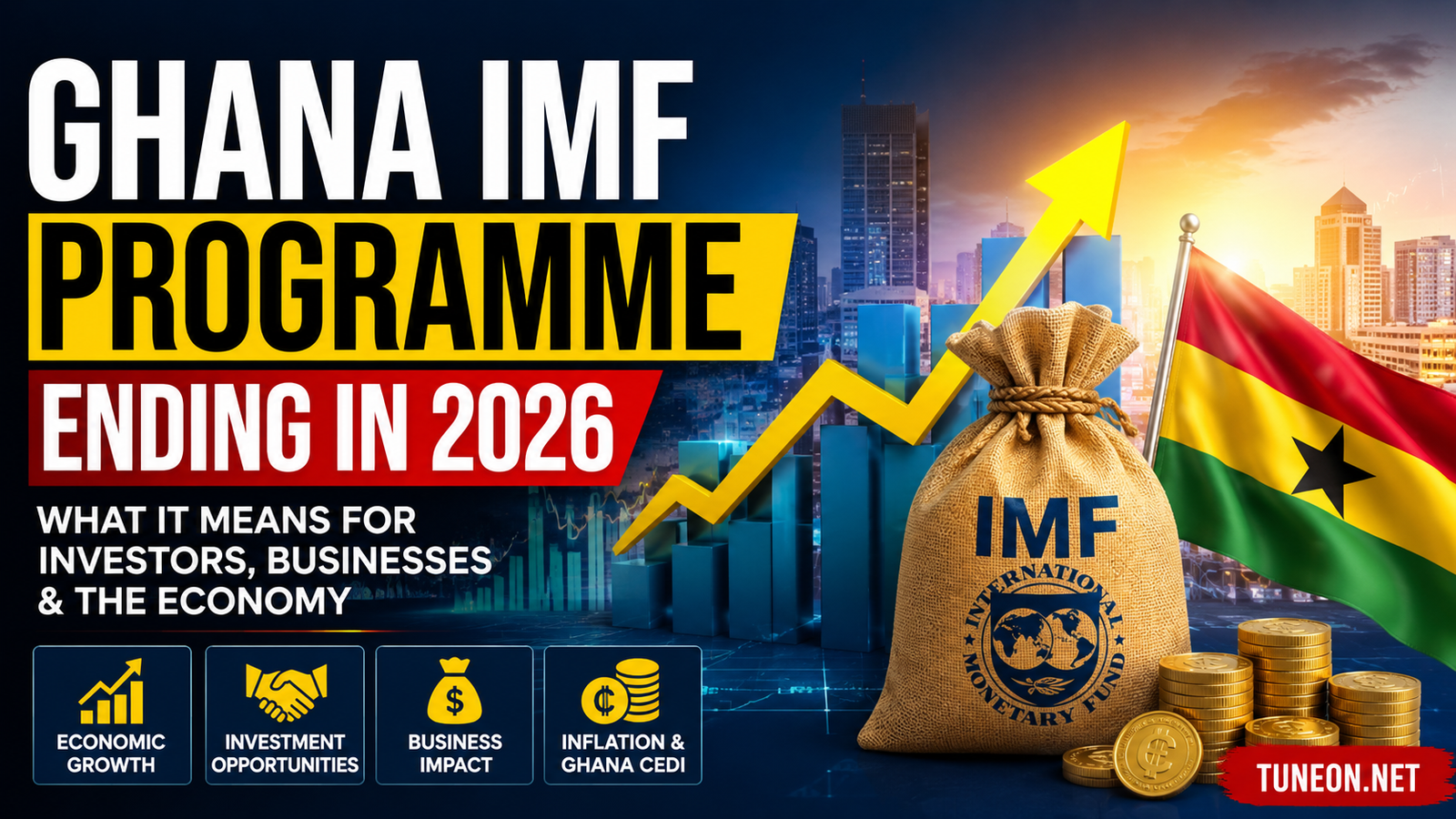
Ghana IMF Programme Ending in 2026: What it means for investors, businesses, and Ghana's economic future.
Ghana IMF Programme Ends 2026: Effects on Ghana’s Economy, Businesses & Investors
The Ghana IMF Programme Ending in 2026 is one of the largest economic developments that will determine the future of the country. After years of financial reforms, debt restructuring and economic stabilisation efforts under the International Monetary Fund (IMF) support programme, Ghana is ready to enter a new phase of economic growth.

Businesses, investors, entrepreneurs and ordinary citizens are watching closely how the end of the IMF programme will affect inflation, job creation, foreign investment, exchange rates, government spending and economic opportunities. Ghana IMF Programme Ending 2026: What It Means For Ghana’s Economic Future This article discusses Ghana. IMF Programme Ending 2026: What It Means For Ghana’s Economic Future
Understanding Ghana’s IMF Programme
The Ghana IMF Programme ending in 2026 has become one of the most discussed economic topics in the country. The programme was introduced to help Ghana stabilise its economy during a period of financial challenges marked by rising inflation, increasing public debt, currency depreciation, and reduced investor confidence. Through support from the International Monetary Fund (IMF), Ghana has implemented several economic reforms aimed at restoring fiscal discipline, strengthening government finances, and creating a foundation for long-term economic growth.
The IMF programme is officially known as the Extended Credit Facility (ECF), a financial assistance arrangement designed to help countries facing economic difficulties. Ghana sought IMF support to address mounting economic pressures and restore confidence among local and international investors. The programme provides financial assistance while requiring the government to implement specific economic policies and reforms. These reforms focus on improving revenue collection, reducing government expenditure, controlling inflation, strengthening public institutions, and ensuring sustainable debt management.
Understanding the Ghana IMF Programme Ending in 2026 requires examining the economic conditions that led to its implementation. Prior to entering the programme, Ghana experienced significant economic challenges, including high inflation rates, increasing debt obligations, and limited access to international capital markets. The government faced growing fiscal deficits, making it difficult to finance essential public services and development projects. The IMF programme was therefore designed to provide immediate financial relief while helping the country establish stronger economic foundations for the future.
One of the primary goals of the programme is restoring macroeconomic stability. This includes maintaining a stable exchange rate, reducing inflation, and improving public financial management. According to the IMF, successful implementation of these measures can improve investor confidence and attract foreign direct investment into key sectors of the Ghanaian economy. More information about Ghana’s relationship with the IMF can be found at https://www.imf.org/en/Countries/GHA, which provides updates on programme reviews and economic assessments.
The Ghana IMF Programme Ending in 2026 also focuses heavily on debt restructuring and fiscal responsibility. Ghana has worked with international creditors to restructure portions of its debt, reducing financial pressure on government resources. These efforts aim to create a more sustainable debt profile that allows the country to invest in critical sectors such as healthcare, education, infrastructure, and digital transformation. Additional economic data and development information are available through the World Bank’s Ghana page at https://www.worldbank.org/en/country/ghana.
Businesses operating in Ghana have closely monitored the progress of the IMF programme because economic stability directly affects investment decisions, consumer spending, and business growth. A stable economy creates a favourable environment for entrepreneurs, small businesses, and large corporations. As inflation declines and confidence improves, businesses may gain better access to financing and experience increased economic activity.
The programme has also encouraged reforms in tax administration, public expenditure management, and governance. These measures are intended to improve efficiency, reduce waste, and increase government revenue without placing excessive burdens on citizens and businesses. Such reforms are critical for ensuring that economic gains achieved under the programme continue after its conclusion in 2026.
Readers interested in Ghana’s broader economic developments can also explore related coverage on https://myghpages.com/business, https://myghpages.com/finance, https://myghpages.com/economy, and https://myghpages.com/ghana-news. Investors looking for opportunities in the country may find additional insights through https://myghpages.com/investment.
As the Ghana IMF programme ending in 2026 approaches, economists, policymakers, investors, and citizens are evaluating its long-term impact. While challenges remain, the programme has played a significant role in helping Ghana address economic difficulties and lay the groundwork for future growth. The lessons learned and reforms implemented during this period will continue to influence Ghana’s economic direction long after the programme officially concludes.
Why the IMF Programme Was Necessary
The Ghana IMF Programme Ending in 2026 was initiated during one of the most challenging periods in Ghana’s recent economic history. Before the programme began, the country faced a combination of economic pressures that threatened financial stability and long-term growth. Rising inflation, a weakening Ghanaian cedi, increasing public debt, and reduced investor confidence created an environment that required urgent intervention. To address these challenges and restore confidence in the economy, Ghana sought support from the International Monetary Fund (IMF) through an Extended Credit Facility programme.
One of the main reasons the IMF programme became necessary was the rapid increase in Ghana’s public debt. Over the years, government borrowing had grown significantly, leading to higher debt servicing costs and putting pressure on public finances. As debt obligations increased, a larger portion of government revenue was allocated to debt repayment rather than development projects, infrastructure, healthcare, and education. This situation limited the government’s ability to invest in critical sectors that drive economic growth and improve living standards.
At the same time, inflation reached levels that affected businesses and households across the country. The rising cost of goods and services reduced consumers’ purchasing power and increased operational costs for businesses. Many companies struggled with higher production expenses, while families found it increasingly difficult to manage household budgets. The Ghana IMF Programme Ending in 2026 was designed to help reduce inflation through fiscal discipline, improved monetary policies, and stronger economic management.
Another major challenge was the depreciation of the Ghana cedi against major international currencies. A weaker currency increased the cost of imports, fuel, raw materials, and essential goods. Businesses that relied on imported products faced rising costs, which often resulted in higher prices for consumers. Exchange rate instability also discouraged some investors from committing long-term capital to the Ghanaian economy. By working with the IMF, Ghana aimed to strengthen economic fundamentals and improve confidence in the country’s financial system.
Investor confidence had also weakened due to concerns about fiscal sustainability and economic uncertainty. International investors closely monitor economic indicators such as debt levels, inflation, budget deficits, and foreign exchange reserves when making investment decisions. The IMF programme signalled to investors that Ghana was committed to implementing reforms designed to stabilise the economy and improve financial management. This commitment helped reassure investors and encouraged renewed interest in the country’s investment opportunities.
The programme also became necessary because Ghana faced difficulties accessing international financial markets. Rising borrowing costs and declining investor confidence made it more expensive for the government to raise funds through international bonds and other financing instruments. The IMF provided financial support while helping Ghana implement reforms that would improve credibility and eventually restore access to global capital markets. Additional information about Ghana’s economic recovery efforts can be found through the IMF at https://www.imf.org/en/Countries/GHA and the Ministry of Finance at https://www.mofep.gov.gh.
Beyond financial support, the IMF programme introduced reforms aimed at improving tax administration, public expenditure management, and government accountability. These reforms were intended to increase revenue collection, reduce inefficiencies, and ensure that public funds were used more effectively. Stronger governance and transparency measures were viewed as essential components of Ghana’s long-term economic recovery strategy.
The Ghana IMF Programme ending in 2026 has also been important for businesses seeking a stable operating environment. A more predictable economy can encourage investment, create jobs, and support entrepreneurship. Readers interested in Ghana’s business environment can explore https://myghpages.com/business, while those seeking financial updates can visit https://myghpages.com/finance. Additional economic coverage is available at https://myghpages.com/economy, and investment-related news can be found at https://myghpages.com/investment. For broader national developments, readers can also explore https://myghpages.com/ghana-news.
Ultimately, the IMF programme was necessary because Ghana needed a comprehensive strategy to address economic instability, restore confidence, and create conditions for sustainable growth. While the reforms have required difficult decisions, they have helped position the country for a more stable and resilient future. As the Ghana IMF programme ending in 2026 approaches, the progress achieved through these reforms will play a significant role in shaping Ghana’s economic trajectory for years to come.
Why the IMF Programme Was Necessary
The Ghana IMF Programme Ending in 2026 was initiated during one of the most challenging periods in Ghana’s recent economic history. Before the programme began, the country faced a combination of economic pressures that threatened financial stability and long-term growth. Rising inflation, a weakening Ghanaian cedi, increasing public debt, and reduced investor confidence created an environment that required urgent intervention. To address these challenges and restore confidence in the economy, Ghana sought support from the International Monetary Fund (IMF) through an Extended Credit Facility programme.
One of the main reasons the IMF programme became necessary was the rapid increase in Ghana’s public debt. Over the years, government borrowing had grown significantly, leading to higher debt servicing costs and putting pressure on public finances. As debt obligations increased, a larger portion of government revenue was allocated to debt repayment rather than development projects, infrastructure, healthcare, and education. This situation limited the government’s ability to invest in critical sectors that drive economic growth and improve living standards.
At the same time, inflation reached levels that affected businesses and households across the country. The rising cost of goods and services reduced consumers’ purchasing power and increased operational costs for businesses. Many companies struggled with higher production expenses, while families found it increasingly difficult to manage household budgets. The Ghana IMF Programme Ending in 2026 was designed to help reduce inflation through fiscal discipline, improved monetary policies, and stronger economic management.
Another major challenge was the depreciation of the Ghana cedi against major international currencies. A weaker currency increased the cost of imports, fuel, raw materials, and essential goods. Businesses that relied on imported products faced rising costs, which often resulted in higher prices for consumers. Exchange rate instability also discouraged some investors from committing long-term capital to the Ghanaian economy. By working with the IMF, Ghana aimed to strengthen economic fundamentals and improve confidence in the country’s financial system.
Investor confidence had also weakened due to concerns about fiscal sustainability and economic uncertainty. International investors closely monitor economic indicators such as debt levels, inflation, budget deficits, and foreign exchange reserves when making investment decisions. The IMF programme signalled to investors that Ghana was committed to implementing reforms designed to stabilise the economy and improve financial management. This commitment helped reassure investors and encouraged renewed interest in the country’s investment opportunities.
The programme also became necessary because Ghana faced difficulties accessing international financial markets. Rising borrowing costs and declining investor confidence made it more expensive for the government to raise funds through international bonds and other financing instruments. The IMF provided financial support while helping Ghana implement reforms that would improve credibility and eventually restore access to global capital markets. Additional information about Ghana’s economic recovery efforts can be found through the IMF at https://www.imf.org/en/Countries/GHA and the Ministry of Finance at https://www.mofep.gov.gh.
Beyond financial support, the IMF programme introduced reforms aimed at improving tax administration, public expenditure management, and government accountability. These reforms were intended to increase revenue collection, reduce inefficiencies, and ensure that public funds were used more effectively. Stronger governance and transparency measures were viewed as essential components of Ghana’s long-term economic recovery strategy.
The Ghana IMF Programme ending in 2026 has also been important for businesses seeking a stable operating environment. A more predictable economy can encourage investment, create jobs, and support entrepreneurship. Readers interested in Ghana’s business environment can explore https://myghpages.com/business, while those seeking financial updates can visit https://myghpages.com/finance. Additional economic coverage is available at https://myghpages.com/economy, and investment-related news can be found at https://myghpages.com/investment. For broader national developments, readers can also explore https://myghpages.com/ghana-news.
Ultimately, the IMF programme was necessary because Ghana needed a comprehensive strategy to address economic instability, restore confidence, and create conditions for sustainable growth. While the reforms have required difficult decisions, they have helped position the country for a more stable and resilient future. As the Ghana IMF programme ending in 2026 approaches, the progress achieved through these reforms will play a significant role in shaping Ghana’s economic trajectory for years to come.
Economic Progress Achieved Under the Programme
The Ghana IMF Programme ending in 2026 has played a major role in helping the country make significant economic progress during a period of financial uncertainty. Since the programme began, Ghana has implemented a series of reforms aimed at restoring macroeconomic stability, strengthening public finances, rebuilding investor confidence, and creating a foundation for sustainable economic growth. While challenges remain, many economic indicators have shown signs of improvement, demonstrating the impact of the reforms introduced under the IMF-supported programme.
One of the most notable achievements of the programme has been the restoration of fiscal discipline. Before entering the IMF arrangement, Ghana faced growing budget deficits and increasing pressure on public finances. Government spending often exceeded revenue generation, resulting in higher borrowing levels and rising debt obligations. Through the reforms introduced under the programme, the government has worked to improve revenue collection, strengthen expenditure controls, and enhance budget management practices. These measures have helped improve financial accountability and reduce fiscal imbalances.
The Ghana IMF Programme ending in 2026 has also contributed to efforts aimed at reducing inflation. High inflation had become a major concern for households and businesses across the country, increasing the cost of living and reducing purchasing power. Through coordinated fiscal and monetary policies, Ghana has made progress in stabilising prices and reducing inflationary pressures. Lower inflation benefits businesses by creating a more predictable operating environment while helping consumers manage their expenses more effectively.
Another significant area of progress has been debt restructuring and debt sustainability. Ghana undertook comprehensive debt restructuring efforts to address rising public debt levels and reduce pressure on government finances. These initiatives involved negotiations with both domestic and international creditors, allowing the country to create a more manageable debt profile. By improving debt sustainability, Ghana has been able to focus more resources on development priorities and essential public services. Detailed information about Ghana’s fiscal reforms and economic strategy can be found through the Ministry of Finance at https://www.mofep.gov.gh and economic reports published by the IMF at https://www.imf.org/en/Countries/GHA.
Investor confidence has also improved under the programme. Economic stability is one of the most important factors considered by local and international investors when making investment decisions. The implementation of reforms, combined with ongoing policy adjustments, has helped reassure investors that Ghana is committed to maintaining a stable and transparent economic environment. Increased confidence can attract foreign direct investment into sectors such as manufacturing, agriculture, technology, renewable energy, infrastructure, and financial services.
The banking and financial sectors have also benefited from the programme’s reforms. Financial institutions operate more effectively in stable economic conditions, and improved confidence in the economy can support lending activities and business expansion. Stronger financial sector oversight and prudent monetary policies have contributed to greater resilience within Ghana’s banking system, helping to protect businesses and consumers from economic shocks.
The Ghana IMF programme ending in 2026 has further encouraged improvements in governance, transparency, and public sector management. Measures aimed at enhancing accountability and reducing inefficiencies have strengthened public institutions and improved confidence in government operations. These reforms are expected to provide long-term benefits even after the IMF programme concludes.
Businesses and entrepreneurs have started to experience some of the positive effects of economic stabilisation. A more predictable business environment allows companies to plan for growth, invest in expansion, and create employment opportunities. Readers interested in business developments can explore https://myghpages.com/business, while financial news and market updates are available through https://myghpages.com/finance. Additional economic analysis can be found at https://myghpages.com/economy, and investors can access opportunities and insights through https://myghpages.com/investment. National developments affecting the economy are also covered at https://myghpages.com/ghana-news.
Another achievement under the programme has been the rebuilding of international confidence in Ghana’s economy. International development partners, multilateral institutions, and foreign investors closely monitor economic reforms when assessing investment destinations. Progress made under the IMF programme has strengthened Ghana’s reputation as a country committed to responsible economic management and long-term development.
As the Ghana IMF programme ending in 2026 approaches, the economic progress achieved so far provides a strong foundation for future growth. Although challenges such as unemployment, infrastructure development, and revenue mobilisation still require attention, the reforms implemented under the programme have improved stability and created new opportunities for businesses, investors, and citizens. The success of these reforms will continue to influence Ghana’s economic outlook well beyond 2026, positioning the country for sustainable growth and increased competitiveness in the global economy.
What Happens When the IMF Programme Ends in 2026?

The Ghana IMF programme ending in 2026 marks a significant turning point in the country’s economic journey. After years of implementing fiscal reforms, debt restructuring measures, and economic stabilisation policies under the supervision of the International Monetary Fund (IMF), Ghana is preparing to transition into a new phase where economic management will largely depend on domestic institutions and government policy decisions. While the conclusion of the programme is a major milestone, it does not mean that economic reforms will come to an end. Instead, it represents the beginning of a new chapter in which Ghana must maintain the progress achieved under the IMF arrangement while pursuing sustainable economic growth.
One of the most important aspects of the Ghana IMF Programme Ending in 2026 is that the government will no longer receive direct policy oversight through the current IMF support programme. During the programme period, Ghana committed to specific fiscal targets, debt management strategies, and economic reforms that were regularly reviewed by IMF officials. These reviews helped ensure that economic objectives were being met and that financial assistance remained available. Once the programme ends, the responsibility for maintaining fiscal discipline and implementing reforms will rest primarily with Ghana’s own institutions.
A key question many economists and investors are asking is whether Ghana can sustain economic stability without IMF supervision. The answer largely depends on the government’s ability to continue implementing prudent fiscal policies. This includes controlling public spending, improving tax collection, managing public debt responsibly, and maintaining transparency in government finances. Information about fiscal policy and government financial management can be found through the Ministry of Finance at https://www.mofep.gov.gh, while monetary policy updates are regularly published by the Bank of Ghana at https://www.bankofghana.com.
The Ghana IMF Programme Ending in 2026 could also influence investor confidence. International investors often view successful completion of an IMF programme as a positive signal that a country is committed to sound economic management. If Ghana continues to maintain economic stability after the programme ends, it could strengthen investor confidence and attract new investments into sectors such as manufacturing, technology, agriculture, renewable energy, infrastructure, and financial services. Increased investment can create jobs, stimulate business growth, and contribute to higher economic output.
Another important consideration is the future of inflation and exchange rate stability. During the IMF programme, the government and the Bank of Ghana implemented measures designed to reduce inflation and stabilise the Ghana cedi. These policies have helped improve economic conditions and restore confidence among businesses and consumers. However, maintaining these gains after 2026 will require continued coordination between fiscal and monetary authorities. A stable exchange rate and manageable inflation levels are essential for supporting businesses, protecting consumer purchasing power, and encouraging long-term investment.
Businesses and entrepreneurs are expected to play an increasingly important role after the Ghana IMF programme ends in 2026. A stable economic environment can encourage business expansion, innovation, and job creation. Entrepreneurs may find new opportunities in sectors supported by government development initiatives and private sector investment. Readers interested in business opportunities can explore https://myghpages.com/business for updates on entrepreneurship and corporate developments. Additional financial news and market analysis can be found at https://myghpages.com/finance, while broader economic coverage is available at https://myghpages.com/economy. Investors can also stay informed through https://myghpages.com/investment and follow national developments through https://myghpages.com/ghana-news.
The end of the IMF programme may also provide greater flexibility for policymakers. While fiscal discipline will remain essential, the government could have more freedom to design policies tailored specifically to Ghana’s economic priorities. This may include initiatives focused on industrialisation, infrastructure development, digital transformation, job creation, and support for small and medium-sized enterprises. The challenge will be balancing economic growth objectives with the need to maintain financial stability and avoid excessive borrowing.
There are also risks associated with the post-IMF period. If fiscal discipline weakens or economic reforms are reversed, Ghana could face renewed economic pressures, including inflationary challenges, debt concerns, and reduced investor confidence. For this reason, economists emphasise the importance of maintaining the reforms that have contributed to economic stabilisation over the past several years.
Ultimately, the Ghana IMF programme ending in 2026 should not be viewed as the end of Ghana’s economic reform journey. Instead, it represents a transition toward greater economic independence and responsibility. The progress achieved under the programme has created opportunities for growth, investment, and development. Whether these gains are sustained will depend on the government’s commitment to sound economic policies, strong institutions, and continued support for private sector development. If managed effectively, the post-2026 period could position Ghana as one of Africa’s most resilient and attractive economies for investors and businesses alike.
Impact on Businesses and Entrepreneurs
The Ghana IMF Programme Ending in 2026 is expected to have a significant impact on businesses and entrepreneurs across the country. Over the past few years, the IMF-supported reforms have helped stabilise Ghana’s economy, improve investor confidence, and create a more predictable business environment. As Ghana prepares to exit the programme, many business owners, investors, and startup founders are closely monitoring what comes next and how the post-IMF era could influence growth opportunities, access to finance, consumer spending, and overall economic activity.
One of the most important benefits of the Ghana IMF Programme ending in 2026 is the improved economic stability that has emerged during the reform period. Businesses thrive in stable environments where inflation is controlled, exchange rates are relatively predictable, and economic policies are consistent. Prior to the IMF programme, many businesses struggled with rising operational costs, currency depreciation, and economic uncertainty. These challenges affected profitability, planning, and investment decisions. Through fiscal reforms and monetary policy adjustments, Ghana has made progress toward creating conditions that support long-term business growth.
For entrepreneurs, economic stability can create new opportunities to launch and expand businesses. Investors are generally more willing to support startups and growing companies when they have confidence in the broader economy. As the Ghana IMF programme ending in 2026 approaches, improved investor sentiment may encourage additional funding for small and medium-sized enterprises (SMEs), technology startups, agribusinesses, manufacturing firms, and service providers. This could lead to increased job creation and innovation across various sectors of the economy.
Access to financing is another area where businesses could benefit. During periods of economic instability, financial institutions often become more cautious when lending money. Higher inflation and uncertainty can result in increased interest rates and stricter lending requirements. However, as economic conditions improve, banks and financial institutions may become more willing to provide loans and credit facilities to businesses. Entrepreneurs seeking funding may find a more supportive financial environment if Ghana maintains the reforms introduced under the IMF programme. Information about Ghana’s investment climate and business opportunities can be found through https://www.gipc.gov.gh and economic development updates from the World Bank at https://www.worldbank.org/en/country/ghana.
The Ghana IMF Programme Ending in 2026 could also support growth in consumer spending. When inflation decreases and economic confidence improves, consumers are generally more willing to spend money on goods and services. Increased consumer demand can benefit businesses in sectors such as retail, hospitality, transportation, telecommunications, real estate, healthcare, and education. Strong consumer activity is often a key driver of economic growth and business expansion.
Foreign direct investment is expected to play a major role in shaping opportunities for businesses after 2026. International investors often seek stable and growing economies when deciding where to allocate capital. If Ghana continues to demonstrate strong economic management after the IMF programme concludes, the country could attract increased investment into sectors such as renewable energy, agriculture, mining, technology, manufacturing, logistics, and infrastructure. These investments can create partnerships for local businesses and generate employment opportunities throughout the economy.
Business owners should also recognise that the end of the IMF programme does not eliminate economic challenges. Companies will still need to adapt to changing market conditions, manage operational costs, and remain competitive in both local and international markets. Continued government commitment to fiscal discipline and economic reforms will be essential for preserving the stability that businesses require to succeed.
Entrepreneurs looking to stay informed about market opportunities can follow business and economic developments through https://myghpages.com/business, where updates on entrepreneurship and corporate activities are regularly published. Financial news and economic analysis are also available at https://myghpages.com/finance and https://myghpages.com/economy. Investors interested in emerging sectors can explore insights at https://myghpages.com/investment, while broader national developments can be tracked through https://myghpages.com/ghana-news.
Another important outcome of the Ghana IMF Programme ending in 2026 may be increased government focus on private sector development. Policymakers recognise that sustainable economic growth depends heavily on a vibrant private sector capable of creating jobs, generating tax revenue, and driving innovation. Future economic strategies may place greater emphasis on supporting local businesses, attracting investment, improving digital infrastructure, and encouraging entrepreneurship.
Ultimately, the Ghana IMF Programme Ending in 2026 presents both opportunities and responsibilities for Ghana’s business community. While economic stability and improved investor confidence create favourable conditions for growth, businesses must continue to innovate, adapt, and remain competitive. If Ghana successfully maintains the reforms introduced under the IMF programme, entrepreneurs and companies could benefit from a stronger economy, increased investment, and a more supportive environment for long-term success.
Effects on Foreign Direct Investment
The Ghana IMF Programme Ending in 2026 is expected to have a significant influence on foreign direct investment (FDI) and Ghana’s position as an investment destination in Africa. Foreign direct investment plays a critical role in economic development by bringing capital, technology, expertise, and employment opportunities into a country. For many years, Ghana has been regarded as one of West Africa’s leading investment destinations due to its political stability, strategic location, growing consumer market, and natural resources. The successful completion of the IMF programme could further strengthen the country’s attractiveness to international investors.
One of the primary objectives of the IMF programme was to restore investor confidence in Ghana’s economy. Before entering the programme, economic challenges such as high inflation, currency depreciation, rising public debt, and fiscal instability created uncertainty for both domestic and foreign investors. Many international companies and investment funds became cautious about expanding their operations or committing new capital to the country. The reforms implemented under the IMF programme were designed to address these concerns and demonstrate Ghana’s commitment to sound economic management.
The Ghana IMF Programme Ending in 2026 sends an important signal to global investors. Successful completion of an IMF-supported programme often indicates that a country has made progress in stabilising its economy and implementing structural reforms. Investors typically view IMF programme completion as evidence of improved fiscal discipline, stronger institutions, and a more predictable business environment. These factors are critical when multinational corporations and investment funds evaluate potential markets for expansion.
Foreign investors are particularly interested in economic stability because it reduces business risks. Stable inflation, manageable public debt levels, predictable exchange rates, and transparent government policies help companies make long-term investment decisions with greater confidence. Ghana’s progress under the IMF programme has contributed to a more stable economic environment that could encourage new investment projects after 2026. Information about investment opportunities and government initiatives can be found through https://www.gipc.gov.gh, while global economic assessments are available through https://www.worldbank.org/en/country/ghana.
Several sectors are expected to benefit from increased foreign direct investment following the Ghana IMF programme ending in 2026. The technology sector continues to attract interest from international investors seeking opportunities in digital services, fintech, e-commerce, and innovation. Ghana’s young population and expanding internet penetration make it an attractive market for technology-driven businesses. Investment in digital infrastructure could help accelerate economic transformation and create new employment opportunities.
The manufacturing sector also presents significant opportunities for foreign investors. Ghana’s strategic location within the African Continental Free Trade Area (AfCFTA) framework provides access to a large regional market. International manufacturers may view Ghana as a gateway for exporting products across Africa while benefiting from improving infrastructure and economic stability. Increased manufacturing investment can support industrialisation, job creation, and export growth.
Agriculture remains another key sector for foreign direct investment. Ghana has substantial agricultural resources and opportunities for value-added processing. Investors are increasingly interested in agribusiness ventures that focus on food production, export processing, logistics, and supply chain development. Investments in agriculture can improve productivity while supporting rural economic development.
The renewable energy sector could also experience growing investor interest after the Ghana IMF programme ends in 2026. Global demand for sustainable energy solutions continues to increase, and Ghana possesses significant potential in solar, wind, and other renewable energy sources. International investment in clean energy projects can contribute to energy security while supporting environmental sustainability goals.
Businesses and entrepreneurs can benefit from increased foreign investment through partnerships, technology transfer, knowledge sharing, and access to larger markets. Local companies often gain opportunities to participate in supply chains established by multinational corporations. Readers interested in business trends can explore https://myghpages.com/business, while economic updates are available at https://myghpages.com/economy. Financial market developments can be followed through https://myghpages.com/finance, and investment-related news is available at https://myghpages.com/investment. Broader national developments can also be accessed through https://myghpages.com/ghana-news.
Despite these opportunities, maintaining investor confidence after the IMF programme ends will require continued commitment to sound economic policies. Investors will closely monitor government spending, debt management, inflation control, and regulatory reforms. Any signs of fiscal instability could affect investment decisions and slow capital inflows. Therefore, preserving the gains achieved under the IMF programme will be essential for sustaining investment momentum.
Ultimately, the Ghana IMF Programme ending in 2026 has the potential to position Ghana as one of Africa’s most attractive destinations for foreign direct investment. If economic reforms continue and investor confidence remains strong, the country could attract substantial capital inflows that support economic growth, infrastructure development, industrial expansion, and job creation. The post-IMF period offers an opportunity for Ghana to build on its achievements and strengthen its reputation as a stable and competitive investment destination in the global economy.
Implications for the Ghanaian Cedi and Inflation
The Ghana IMF Programme Ending in 2026 is expected to have major implications for the Ghana cedi and inflation, two of the most important economic indicators affecting businesses, investors, and households. Throughout the IMF-supported reform period, stabilising the national currency and reducing inflation have been key priorities. The success of these efforts has helped improve economic confidence, but many Ghanaians are now asking whether these gains can be sustained after the programme officially concludes in 2026.
Before the IMF programme began, Ghana experienced significant economic challenges that contributed to a sharp depreciation of the Ghana cedi and rising inflation. The weakening currency increased the cost of imports, including fuel, machinery, food products, and industrial raw materials. As import costs rose, businesses passed these expenses on to consumers, leading to higher prices across the economy. Inflation reached levels that significantly affected household budgets, reduced purchasing power, and increased uncertainty for businesses.
The Ghana IMF programme ending in 2026 has been accompanied by policy measures aimed at restoring confidence in the cedi and controlling inflation. Through tighter fiscal management, debt restructuring, and coordinated monetary policies implemented by the Bank of Ghana, the country has made progress toward stabilising economic conditions. Lower inflation and improved exchange rate stability have helped create a more predictable environment for businesses and consumers.
A stable Ghanaian cedi is important because it directly affects the cost of imported goods and services. Ghana relies on imports for many products used in manufacturing, transportation, healthcare, telecommunications, and retail. When the cedi remains relatively stable against major currencies such as the US dollar, import costs become more predictable, allowing businesses to plan more effectively. This stability can reduce pressure on prices and support economic growth. Monetary policy updates and exchange rate information are available through https://www.bankofghana.com, while broader economic assessments can be accessed through https://www.imf.org/en/Countries/GHA.
Inflation control remains one of the most important challenges after the Ghana IMF programme ends in 2026. Inflation affects every sector of the economy because it influences consumer spending, business profitability, investment decisions, and government finances. High inflation erodes purchasing power, making it more difficult for families to afford essential goods and services. It also increases operational costs for businesses, reducing profit margins and potentially slowing investment activity.
The Bank of Ghana is expected to continue playing a crucial role in maintaining inflation stability after the IMF programme ends. Through monetary policy tools such as interest rate adjustments, liquidity management, and inflation targeting frameworks, the central bank can help manage price pressures and support exchange rate stability. However, monetary policy alone cannot guarantee success. Fiscal discipline by the government will also be essential to prevent excessive borrowing and spending that could contribute to inflationary pressures.
The Ghana IMF programme ending in 2026 may also influence investor perceptions of the cedi. Investors closely monitor exchange rate movements when evaluating investment opportunities. A stable currency reduces financial risk and increases confidence among both domestic and international investors. If Ghana successfully maintains the economic reforms introduced under the IMF programme, investor confidence could strengthen further, supporting capital inflows and foreign direct investment.
Businesses across various industries will continue to be affected by exchange rate and inflation trends. Companies involved in importation, manufacturing, retail, logistics, and energy are particularly sensitive to currency fluctuations. A stable cedi can help reduce uncertainty and improve profitability, while lower inflation can support consumer demand and economic activity. Entrepreneurs seeking market insights can follow developments through https://myghpages.com/business, while financial news and analysis are available at https://myghpages.com/finance. Additional economic coverage can be found at https://myghpages.com/economy, and investment-related updates are available at https://myghpages.com/investment. Readers interested in broader national developments can also visit https://myghpages.com/ghana-news.
Despite the progress achieved under the IMF programme, risks remain. Global economic conditions, commodity price fluctuations, geopolitical events, and external financial shocks can all affect the Ghana cedi and inflation. As a result, policymakers will need to remain vigilant and responsive to emerging economic challenges. Maintaining adequate foreign exchange reserves, supporting exports, and encouraging local production can help strengthen the economy against external pressures.
Ultimately, the Ghana IMF Programme Ending in 2026 represents an important test of Ghana’s ability to maintain economic stability independently. The future performance of the Ghana cedi and inflation will depend on continued fiscal discipline, prudent monetary policy, investor confidence, and sustainable economic reforms. If these factors remain in place, Ghana can build on the progress achieved under the programme and create a more stable environment for businesses, investors, and citizens in the years ahead.
Opportunities for the Private Sector

The Ghana IMF Programme ending in 2026 is expected to create significant opportunities for the private sector as the country transitions into a new phase of economic development. While the IMF programme focused primarily on restoring fiscal discipline, stabilising inflation, and strengthening economic fundamentals, the next stage of Ghana’s growth is likely to depend heavily on the ability of private businesses, entrepreneurs, investors, and innovators to drive economic expansion. A strong private sector is widely recognised as one of the most effective engines of job creation, investment, innovation, and long-term economic prosperity.
One of the most important opportunities arising from the Ghana IMF programme ending in 2026 is the potential for increased investor confidence. Economic stability encourages both domestic and foreign investors to commit capital to business ventures and development projects. As Ghana demonstrates its ability to maintain fiscal discipline and macroeconomic stability beyond the IMF programme, investors may view the country as a more attractive destination for long-term investment. Increased investment can stimulate growth across sectors such as manufacturing, technology, agriculture, energy, construction, logistics, healthcare, and financial services.
The private sector is expected to benefit from a more predictable business environment. During periods of economic uncertainty, businesses often postpone expansion plans and reduce investment due to concerns about inflation, exchange rate fluctuations, and policy instability. However, the reforms implemented under the IMF programme have contributed to greater economic stability. If these reforms continue after 2026, businesses may have greater confidence to expand operations, hire additional workers, invest in new technologies, and enter new markets.
The Ghana IMF Programme Ending in 2026 may also encourage entrepreneurship and innovation. Startups and small businesses play a vital role in economic growth, particularly in developing economies. Improved access to financing, stronger investor confidence, and supportive government policies can create favourable conditions for entrepreneurs to launch new ventures. Sectors such as fintech, e-commerce, agritech, renewable energy, digital services, and software development are expected to offer significant opportunities for innovation and business growth in the coming years.
Technology is likely to be one of the key drivers of private sector expansion after the IMF programme ends. Ghana’s growing digital economy has attracted increasing attention from investors and technology companies. Mobile banking, digital payments, online marketplaces, and digital financial services continue to expand rapidly across the country. Businesses that leverage technology to improve efficiency and reach new customers may benefit from growing demand for digital solutions. Information about business opportunities and investment initiatives can be found through https://www.gipc.gov.gh, while private sector advocacy and economic development resources are available at https://www.ghanachamber.org.
Agriculture also presents major opportunities for private sector growth. Ghana possesses vast agricultural resources and significant potential for value-added processing. Private investment in agribusiness can improve productivity, enhance food security, increase exports, and create employment opportunities in rural communities. Companies involved in food processing, agricultural technology, logistics, and export-orientated production may benefit from policies designed to support economic diversification and industrialisation.
Manufacturing and industrial development are expected to remain important priorities after the Ghana IMF programme ends in 2026. Ghana’s participation in the African Continental Free Trade Area (AfCFTA) creates opportunities for businesses to access larger regional markets. Manufacturers can benefit from increased trade opportunities, improved infrastructure, and growing consumer demand across Africa. Private sector participation in industrial projects can contribute significantly to economic growth and export expansion.
Financial services and investment management are additional sectors that may experience growth as economic conditions improve. Stable economic environments often encourage increased lending, investment activity, and capital market development. Businesses seeking financing for expansion may find greater opportunities if investor confidence remains strong and financial institutions continue to support private sector development.
Entrepreneurs and business owners can stay informed about emerging opportunities through https://myghpages.com/business, which provides coverage of business trends and market developments. Financial updates and economic analysis are available at https://myghpages.com/finance, while broader economic news can be accessed through https://myghpages.com/economy. Investors can explore opportunities through https://myghpages.com/investment, and national developments affecting businesses can be followed at https://myghpages.com/ghana-news.
The government is also expected to play an important role in supporting private sector growth after the IMF programme ends. Policies that promote investment, improve infrastructure, strengthen regulatory frameworks, and support entrepreneurship can help create an environment where businesses thrive. Public-private partnerships may become increasingly important in areas such as transportation, energy, healthcare, education, and digital infrastructure development.
Ultimately, the Ghana IMF Programme Ending in 2026 presents a unique opportunity for the private sector to become a leading force in Ghana’s economic transformation. By leveraging improved economic stability, attracting investment, embracing innovation, and expanding into new markets, businesses can contribute to job creation, economic diversification, and sustainable growth. The success of Ghana’s post-IMF era will depend largely on the strength, resilience, and competitiveness of its private sector.
Challenges Ghana Must Address
While the Ghana IMF Programme Ending in 2026 represents a major milestone in the country’s economic recovery journey, several challenges remain that Ghana must address to ensure long-term stability and sustainable growth. The progress achieved under the IMF-supported reforms has improved economic conditions, strengthened investor confidence, and restored some degree of fiscal discipline. However, maintaining these gains after the programme ends will require continued commitment to responsible economic management, strong institutions, and strategic policymaking.
One of the most significant challenges facing Ghana after the Ghana IMF programme ends in 2026 is public debt management. Although the country has made progress through debt restructuring agreements and fiscal reforms, debt levels remain an important concern. Managing debt sustainably will require careful borrowing practices, increased domestic revenue generation, and efficient public spending. If debt obligations rise too quickly in the future, they could place renewed pressure on government finances and limit the country’s ability to fund essential development projects. Economic updates and debt management policies can be monitored through https://www.imf.org/en/Countries/GHA and fiscal reports published by https://www.mofep.gov.gh.
Another critical challenge is unemployment, particularly among young people. Ghana has a rapidly growing population, and creating sufficient employment opportunities remains one of the country’s most pressing economic priorities. While economic growth can help generate jobs, policymakers must ensure that growth translates into meaningful employment opportunities across sectors such as agriculture, manufacturing, technology, construction, healthcare, and services. Failure to address unemployment could affect social stability and reduce the economic benefits of future growth.
Inflation control will continue to be another major challenge after the IMF programme concludes. Although inflation has shown signs of improvement during the reform period, maintaining price stability requires ongoing coordination between fiscal and monetary authorities. Rising global commodity prices, exchange rate fluctuations, supply chain disruptions, and external economic shocks can all contribute to inflationary pressures. The Bank of Ghana will need to continue implementing prudent monetary policies to maintain confidence in the economy and protect consumers from excessive price increases.
The Ghana IMF programme ending in 2026 also highlights the importance of strengthening domestic revenue mobilisation. One of the lessons learned during the reform period is that sustainable development requires a strong and efficient revenue collection system. Increasing tax compliance, broadening the tax base, and reducing revenue leakages will help the government generate resources needed for infrastructure, healthcare, education, and social programmes. Strong revenue generation can reduce dependence on external borrowing and improve fiscal sustainability.
Infrastructure development remains another challenge that Ghana must address to support long-term economic growth. While progress has been made in sectors such as transportation, energy, telecommunications, and digital infrastructure, significant investment is still required. Efficient infrastructure reduces business costs, improves productivity, attracts investment, and enhances overall economic competitiveness. Expanding infrastructure networks will be particularly important for supporting industrialisation and regional trade opportunities under the African Continental Free Trade Area (AfCFTA).
Governance and institutional strengthening are also essential for sustaining the benefits of the Ghana IMF Programme Ending in 2026. Effective institutions help ensure transparency, accountability, and efficient use of public resources. Investors and development partners often consider governance standards when evaluating economic opportunities. Continued reforms aimed at improving public sector efficiency and reducing corruption can strengthen confidence in Ghana’s economic management and attract additional investment.
Businesses and investors must also be prepared for external economic risks that could affect Ghana’s economy. Global financial market volatility, geopolitical tensions, commodity price fluctuations, climate-related challenges, and changes in international trade patterns can all impact economic performance. Developing resilience against external shocks will require economic diversification, strong financial institutions, and effective risk management strategies.
Private sector development remains crucial for addressing many of these challenges. Entrepreneurs and businesses can contribute to job creation, innovation, investment, and economic diversification. Readers interested in business developments can follow updates at https://myghpages.com/business, while financial market analysis is available through https://myghpages.com/finance. Economic news and policy updates can be found at https://myghpages.com/economy, and investment-related opportunities are covered at https://myghpages.com/investment. Broader national developments affecting the economy can also be followed through https://myghpages.com/ghana-news.
The challenge of balancing social spending with fiscal discipline will also remain important after the IMF programme ends. Governments must invest in healthcare, education, social protection, and poverty reduction programmes while maintaining responsible budget management. Achieving this balance requires efficient resource allocation and long-term planning to ensure that economic growth benefits all citizens.
Ultimately, the Ghana IMF Programme Ending in 2026 provides an opportunity for Ghana to build on the progress achieved through economic reforms. However, the country’s future success will depend on its ability to address remaining challenges effectively. By maintaining fiscal discipline, strengthening institutions, creating jobs, investing in infrastructure, and supporting private sector growth, Ghana can position itself for sustained economic development and increased prosperity in the years ahead.
The Future of Ghana’s Economy Beyond 2026
The Ghana IMF Programme Ending in 2026 represents more than the conclusion of an economic assistance programme. It marks the beginning of a new phase in Ghana’s economic development journey. Over the past several years, Ghana has implemented significant fiscal reforms, debt restructuring measures, and economic stabilisation policies under the guidance of the International Monetary Fund. As the programme comes to an end, attention is shifting toward the future and the opportunities that lie ahead for businesses, investors, entrepreneurs, and citizens.
The future of Ghana’s economy beyond 2026 will largely depend on the country’s ability to maintain fiscal discipline, attract investment, strengthen institutions, and promote sustainable economic growth. One of the most important lessons from the IMF programme is that economic stability creates a strong foundation for development. If Ghana continues implementing responsible economic policies, it could position itself as one of Africa’s leading destinations for investment, innovation, and business expansion.
A key driver of future growth will be private sector development. The government alone cannot create all the jobs and investment opportunities needed to support a growing population. Instead, businesses and entrepreneurs will play a central role in driving economic expansion. Sectors such as technology, agriculture, manufacturing, financial services, renewable energy, healthcare, logistics, tourism, and real estate are expected to offer significant growth opportunities in the years ahead. Readers interested in entrepreneurship and business opportunities can follow updates through https://myghpages.com/business, while economic developments are covered regularly at https://myghpages.com/economy.
The Ghana IMF Programme ending in 2026 could also enhance Ghana’s reputation among international investors. Successful completion of the programme demonstrates the country’s commitment to economic reforms and responsible financial management. This credibility can help attract foreign direct investment into strategic sectors that create jobs and stimulate economic activity. Investors seeking insights into Ghana’s investment environment can explore opportunities through https://myghpages.com/investment and monitor financial trends through https://myghpages.com/finance.
Another important factor shaping Ghana’s future economy is regional trade. Ghana hosts the headquarters of the African Continental Free Trade Area (AfCFTA), providing unique opportunities to become a regional trade and investment hub. Businesses operating in Ghana may gain access to larger markets across Africa, increasing export opportunities and supporting industrial development. Improved infrastructure, efficient logistics systems, and supportive trade policies will be essential for maximising these benefits.
Digital transformation is expected to play an increasingly important role in economic growth beyond the Ghana IMF Programme Ending in 2026. Advances in financial technology, digital payments, e-commerce, artificial intelligence, cloud computing, and telecommunications are creating new business opportunities across the economy. Ghana’s young and technologically savvy population positions the country well to benefit from digital innovation and emerging technologies.
Infrastructure development will remain a priority in the post-IMF era. Investments in transportation networks, energy systems, ports, airports, digital infrastructure, and industrial parks can improve productivity and attract investment. Strong infrastructure reduces business costs and supports economic competitiveness, making it easier for companies to operate efficiently and expand their activities.
Human capital development will also be critical for long-term success. Investing in education, vocational training, healthcare, and workforce development can help prepare Ghanaians for opportunities in a rapidly evolving global economy. A skilled workforce attracts investment and supports innovation across industries.

The Ghana IMF Programme Ending in 2026 does not eliminate future challenges. The government must continue addressing issues such as unemployment, public debt management, inflation control, and revenue mobilisation. Global economic uncertainties, commodity price fluctuations, and external shocks could also affect economic performance. Maintaining economic resilience will require strong institutions, prudent policymaking, and effective governance.
For readers seeking reliable information about Ghana’s future economic direction, the following authority resources provide valuable insights and updates:
https://www.imf.org/en/Countries/GHA
https://www.worldbank.org/en/country/ghana
Readers can also stay updated on Ghanaian business, investment, and economic news through https://myghpages.com/business, https://myghpages.com/finance, https://myghpages.com/economy, https://myghpages.com/investment, and https://myghpages.com/ghana-news.
Ultimately, the Ghana IMF Programme Ending in 2026 creates an opportunity for Ghana to build a stronger, more resilient, and more competitive economy. If policymakers, businesses, investors, and citizens continue working toward sustainable growth and economic transformation, the country could emerge as one of Africa’s leading economic success stories in the years ahead. The post-2026 period offers the potential for greater prosperity, increased investment, and expanded opportunities for future generations.
FAQ
What is the Ghana IMF Programme Ending in 2026?
The Ghana IMF Programme Ending in 2026 refers to the conclusion of Ghana’s economic support and reform programme with the International Monetary Fund aimed at restoring economic stability and growth.
Why did Ghana join the IMF programme?
Ghana joined the IMF programme to address rising debt levels, inflation, currency depreciation, and fiscal challenges affecting the economy.
How will the Ghana IMF programme ending in 2026 affect businesses?
Businesses could benefit from improved economic stability, stronger investor confidence, better financing opportunities, and increased consumer spending.
Will the Ghana cedi improve after the IMF programme ends?
The future performance of the Ghana cedi will depend on continued fiscal discipline, monetary policy management, and investor confidence.
What opportunities exist after the Ghana IMF Programme Ending in 2026?
Opportunities include increased foreign investment, business expansion, entrepreneurship growth, technology innovation, and private sector development.