
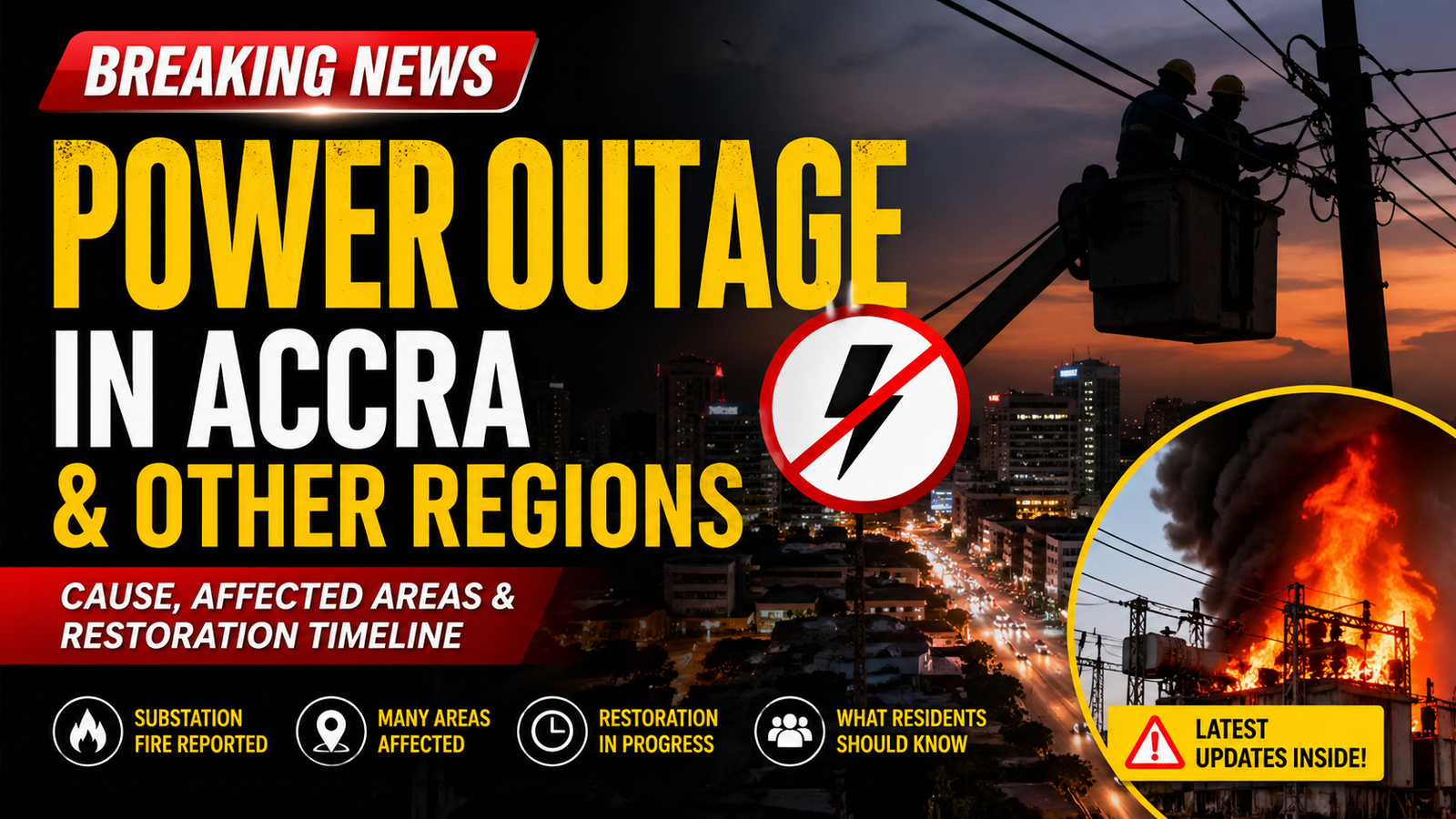
Breaking news: Widespread power outage hits Accra and other regions following electricity system disruption.
A major power outage has hit Accra and several regions across Ghana, causing disruptions to homes, businesses, hospitals, and transportation systems.
The blackout, linked to a fire incident at a key electricity facility, has triggered widespread concern among residents and authorities. As the situation develops, many Ghanaians are searching for updates on the power outage in Accra today, Electricity Company of Ghana (ECG): affected areas, restoration timelines, and safety measures. This developing story is currently one of the top trending news topics in Ghana, attracting high online traffic and public attention.
What Caused the Major Power Outage in Accra and Other Regions
The recent power outage in Accra and other regions has become one of the most talked-about national issues, affecting thousands of homes, businesses, hospitals, and public institutions across Ghana. According to electricity authorities, the widespread blackout was primarily caused by a fire incident at a major electricity transmission facility linked to the national grid system. This unexpected emergency forced engineers to temporarily shut down parts of the power network to prevent further damage and ensure public safety. As a result, electricity supply was disrupted across several communities in the Greater Accra, Eastern, and Volta regions, making the power outage in Accra and other regions a trending topic across news platforms and social media.
Reports indicate that the fire occurred at a critical substation responsible for transmitting electricity from power generation sources to distribution networks. Substations play a vital role in maintaining stable electricity supply, and any disruption at such a facility can lead to large-scale power failures. When the fire broke out, emergency teams quickly responded to contain the situation while technical engineers assessed the damage to equipment and transmission lines. For safety reasons, sections of the grid were temporarily shut down, leading to the sudden blackout experienced by many residents. This explains why the power outage in Accra and other regions happened simultaneously in multiple areas rather than in a single location.
Another contributing factor to the outage was the need to conduct safety inspections before restoring electricity. Engineers must verify that damaged equipment is repaired and that the power system is stable before reconnecting supply to affected communities. Without proper safety checks, restoring electricity too quickly could cause further breakdowns or pose risks such as electrical fires and equipment failure. Therefore, the restoration process often takes time, especially when key infrastructure components are involved.
The power outage in Accra and other regions highlights the importance of maintaining reliable energy infrastructure in Ghana. As electricity demand continues to grow, regular maintenance, system upgrades, and improved emergency response systems are essential to prevent future incidents. Authorities have assured the public that repair works are ongoing and that measures are being implemented to strengthen the national power grid. Residents are encouraged to stay informed through official announcements and follow safety guidelines until full electricity supply is restored.
Regions and Communities Affected by the Power Outage
The recent power outage in Accra and other regions affected several parts of Ghana, causing widespread electricity disruptions in both urban and rural communities. Residents across the Greater Accra Region, Eastern Region, and Volta Region reported sudden blackouts that interrupted daily activities, business operations, and essential services. The outage occurred without warning in many areas, leaving households and companies scrambling to find alternative power sources such as generators and inverters.
In the Greater Accra Region, some of the hardest-hit areas included major commercial and residential communities where electricity demand is typically high. Businesses in these locations experienced temporary shutdowns, while families faced challenges such as lack of lighting, disrupted internet services, and difficulties preserving food due to refrigeration failures. The situation also affected traffic management in certain areas where traffic lights stopped functioning during the blackout.
Some of the key affected areas include the following:
- Accra Central
- Tema
- Kasoa
- Madina
- East Legon
- Adenta
- Ashaiman
- Nsawam
- Ho
- Koforidua
The widespread nature of the power outage in Accra and other regions demonstrates how interconnected Ghana’s electricity grid system is. When a major transmission facility experiences a fault or emergency, multiple regions can be affected simultaneously. Authorities have continued to monitor the situation closely and provide updates to ensure residents understand which areas are impacted and when power restoration is expected.
Impact of the Power Outage on Businesses and Daily Life
The recent power outage in Accra and other regions Ghana Grid Company (GRIDCo): has had a significant impact on businesses, households, and essential services across the affected communities. Many companies rely heavily on electricity to operate equipment, provide services, and maintain productivity. When the blackout occurred, numerous businesses were forced to suspend operations temporarily, leading to financial losses and delays in customer services. Small and medium-sized enterprises, including shops, salons, restaurants, and internet cafés, were among the most affected due to limited access to backup power systems.
For households, the power outage in Accra and other regions disrupted daily routines and created challenges in performing basic tasks. Families experienced difficulties cooking, studying, charging mobile devices, and accessing online services. The lack of electricity also affected water supply in some areas where electric pumps are used to distribute water to homes and communities. In addition, prolonged outages increased the risk of food spoilage, especially for families and businesses that depend on refrigeration to preserve perishable items.
Healthcare facilities and hospitals also felt the impact of the blackout. Although many major hospitals have standby generators, the sudden power interruption placed additional pressure on emergency systems and increased operational costs due to fuel consumption. Clinics and smaller medical centres without reliable backup power faced greater challenges in providing medical services during the outage.
Key effects of the power outage include the following:
- Business revenue losses and reduced productivity
- Disruption of internet and communication services
- Food spoilage due to lack of refrigeration
- Increased transportation and traffic management challenges
- Higher operational costs for businesses using generators
- Interruptions in banking and mobile money services
Overall, the power outage in Accra and other regions highlights the critical role electricity plays in supporting economic activities and daily life in Ghana. Reliable power supply remains essential for business growth, public safety, and national development.
Government and Electricity Authorities Respond to the Situation
The recent power outage in Accra and other regions prompted a swift response from government officials and key electricity sector institutions responsible for managing Ghana’s power supply system. Agencies such as the Ghana Grid Company (GRIDCo), the Volta River Authority (VRA), and the Electricity Company of Ghana (ECG) quickly mobilised technical teams to investigate the cause of the disruption and begin emergency restoration work. Their immediate priority was to contain the incident, assess the extent of damage to critical infrastructure, and restore electricity safely to affected communities.
Following reports of the fire incident at a major transmission facility, engineers and emergency responders were deployed to the site to stabilise the situation. Safety inspections were conducted to ensure that damaged equipment did not pose additional risks to workers or nearby residents. Authorities emphasised that protecting lives and maintaining system stability were more important than rushing the restoration process. As a result, the power outage in Accra and other regions required careful technical evaluation before electricity could be gradually restored.
Government officials also communicated with the public through official statements and media briefings to provide updates on the progress of repair works. Residents were encouraged to remain calm and patient while engineers worked to restore the national grid. In addition, electricity authorities urged customers to report faults such as fallen power lines, sparks, or damaged transformers to prevent accidents and speed up response efforts.
Key actions taken by authorities include the following:
- Deployment of emergency engineering teams to the affected facility
- Conducting safety and technical inspections of damaged equipment
- Coordinating restoration efforts across multiple regions
- Providing public updates through media and official communication channels
- Implementing safety measures to protect workers and residents
The coordinated response by government and electricity authorities demonstrates the importance of rapid emergency management during large-scale power disruptions. Their actions aim to restore stable electricity supply and prevent similar incidents from occurring in the future.
Timeline for Power Restoration in Affected Areas
The restoration of electricity following the recent power outage in Accra and other regions depends on several technical and safety factors that engineers must carefully evaluate. After the fire incident disrupted the transmission system, electricity authorities began immediate repair work to restore supply to affected communities. However, power restoration is typically carried out in stages to ensure the safety and stability of the national grid. This phased approach helps prevent further system failures and protects critical infrastructure from additional damage.
Engineers from GRIDCo, VRA, and ECG have been working continuously to assess the condition of damaged equipment and replace faulty components. The timeline for restoring power varies depending on the severity of the damage and the complexity of repairs required at the affected facility. In some areas, electricity may be restored within a few hours once minor faults are fixed, while heavily affected locations may experience longer delays due to extensive repair work and safety testing.
Authorities have indicated that restoration efforts will prioritize essential services such as hospitals, emergency response centers, and major commercial zones before extending supply to residential communities. This strategy ensures that critical operations continue functioning during emergencies while broader repairs are completed across the network.
Factors That Influence Power Restoration Time Include:
- Extent of damage to transmission equipment
- Availability of replacement parts and technical resources
- Weather conditions and environmental safety
- Completion of safety inspections and system testing
- Coordination among electricity sector agencies
Residents experiencing the power outage in Accra and other regions are advised to stay informed through official announcements from electricity providers and local authorities. Patience and cooperation from the public play an important role in allowing engineers to complete repairs safely and restore reliable electricity supply as quickly as possible.
Safety Measures Residents Should Follow During Power Outages
During the recent power outage in Accra and other regions, safety became a major concern for households, businesses, and communities. Unexpected blackouts can create dangerous situations, especially when electrical appliances suddenly shut down or power is restored without warning. For this reason, electricity authorities and safety experts strongly advise residents to follow basic precautions to protect lives and property during power interruptions. Taking the right safety steps can reduce the risk of fires, electrical damage, and accidents while waiting for electricity to be restored.
One of the most important actions residents should take during a power outage in Accra and other regions is to unplug sensitive electrical devices such as televisions, refrigerators, computers, and chargers. This helps prevent damage caused by power surges when electricity returns. Using candles for lighting should also be done carefully, as open flames can easily start fires, especially in homes with flammable materials nearby. Whenever possible, residents are encouraged to use rechargeable lamps, flashlights, or battery-powered lighting instead of candles.
In addition, families should keep refrigerator and freezer doors closed as much as possible to maintain cold temperatures and prevent food from spoiling. Businesses that rely on generators should ensure that equipment is properly maintained and operated in well-ventilated areas to avoid carbon monoxide poisoning. Residents should also remain alert to hazards such as fallen power lines or damaged electrical poles and report them immediately to electricity authorities or emergency services.
Important Safety Tips to Follow During Power Outages:
- Unplug electrical appliances to prevent damage from power surges
- Use flashlights or rechargeable lamps instead of candles when possible
- Keep refrigerator and freezer doors closed to preserve food
- Avoid touching fallen power lines or exposed wires
- Ensure generators are used in well-ventilated outdoor spaces
- Follow updates and instructions from electricity authorities
Following these safety measures during the power outage in Accra and other regions can help protect families, reduce property damage, and ensure a safer environment until electricity supply is fully restored.
How Power Outages Affect Ghana’s Economy
The recent power outage in Accra and other regions has highlighted the significant role electricity plays in supporting Ghana’s economic activities. Reliable power supply is essential for industries, businesses, financial institutions, and public services. When electricity is disrupted, production slows down, operational costs increase, and businesses may lose revenue. The widespread blackout affected commercial centers, manufacturing companies, and service providers, demonstrating how dependent modern economies are on stable electricity systems.
One of the immediate economic effects of the power outage in Accra and other regions is the loss of productivity. Many factories and processing plants rely on continuous electricity to operate machinery and maintain production schedules. When power is suddenly cut off, production lines stop, orders are delayed, and companies may face financial penalties or customer dissatisfaction. Small businesses, which form a large part of Ghana’s economy, are particularly vulnerable because many lack backup generators or alternative power sources.
Another major impact is the increase in operational costs. Businesses that own generators must spend more money on fuel, maintenance, and equipment during extended power outages. These additional expenses can lead to higher prices for goods and services, affecting consumers and reducing overall purchasing power. In sectors such as retail, hospitality, and telecommunications, power disruptions can also result in service interruptions that reduce customer trust and satisfaction.
The financial sector is also affected during widespread blackouts. Banks, ATMs, and mobile money services depend on electricity and stable internet connections to operate. When these systems go offline, customers may be unable to access funds, complete transactions, or conduct business activities. This situation can slow economic growth and reduce confidence in the reliability of essential services.
Key Economic Effects of Power Outages Include:
- Reduced industrial and business productivity
- Increased operational costs due to generator use
- Loss of revenue for small and medium-sized enterprises
- Disruption of banking and mobile money services
- Higher prices for goods and services
- Reduced investor confidence in the energy sector
Overall, the power outage in Accra and other regions demonstrates how critical reliable electricity is for Ghana’s economic stability and development. Strengthening power infrastructure and improving emergency response systems remain important steps toward protecting businesses and ensuring long-term economic growth.
Public Reactions to the Nationwide Power Outage
The recent power outage in Accra and other regions sparked widespread reactions from the public, with many residents expressing frustration and concern over the sudden disruption of electricity supply. Social media platforms such as Facebook, X (Twitter), and WhatsApp quickly became channels for sharing updates, complaints, and personal experiences related to the blackout. Many users posted photos and videos showing dark neighborhoods, stalled businesses, and traffic congestion caused by malfunctioning traffic lights.
For many households and business owners, the unexpected nature of the power outage in Accra and other regions created uncertainty and inconvenience. Parents worried about their children’s ability to study at night, while entrepreneurs and shop owners voiced concerns about financial losses due to halted operations. In some communities, residents gathered outside their homes to discuss the situation and seek information about when electricity would be restored. The outage also prompted renewed discussions about the reliability of Ghana’s power infrastructure and the need for long-term solutions to prevent recurring disruptions.
Public reactions were not limited to frustration alone. Some citizens used the opportunity to call for improved maintenance of electricity facilities, stronger emergency preparedness, and better communication from electricity providers during crises. Others encouraged patience and cooperation, acknowledging the efforts of engineers and emergency teams working to resolve the issue. Community leaders and public figures also urged residents to remain calm and follow safety guidelines until the situation was fully resolved.
Common Public Concerns During the Power Outage Included:
- Uncertainty about the duration of the blackout
- Lack of timely communication and updates
- Financial losses for businesses and workers
- Safety risks in dark neighborhoods
- Reliability of the national power supply system
- Demand for long-term solutions to prevent future outages
Overall, the strong public reaction to the power outage in Accra and other regions reflects how essential electricity is to modern life. The incident has reinforced the importance of reliable energy systems and effective communication between authorities and citizens during emergencies.
Measures Being Taken to Prevent Future Power Outages
Following the recent power outage in Accra and other regions, electricity authorities and government agencies have begun implementing several long-term measures aimed at preventing similar incidents in the future. The blackout exposed vulnerabilities in parts of the national power infrastructure, prompting stakeholders to focus on improving system reliability, strengthening maintenance procedures, and enhancing emergency response capabilities. These actions are intended to reduce the likelihood of large-scale disruptions and ensure a more stable electricity supply for households and businesses across Ghana.
One of the key strategies being introduced is the modernization of power transmission and distribution equipment. Many components within the electricity network require periodic upgrades to handle increasing demand and changing environmental conditions. By replacing aging infrastructure with modern technology, authorities can improve system performance and reduce the risk of equipment failure. In addition, advanced monitoring systems are being installed to detect faults early and alert engineers before problems escalate into major outages.
Regular maintenance and safety inspections are also being intensified across critical facilities such as substations and transmission lines. Preventive maintenance helps identify potential hazards, including overheating equipment, damaged wiring, or faulty transformers, before they cause disruptions. Authorities are also investing in training programs for technical staff to strengthen their ability to respond quickly and efficiently during emergencies.
Another important measure involves improving fire detection and suppression systems at major electricity facilities. Since the recent incident was linked to a fire outbreak, installing modern fire safety systems will help protect vital infrastructure and minimize damage in case of emergencies. Authorities are also working to enhance coordination among power sector institutions to ensure faster communication and response during future incidents.
Key Measures to Prevent Future Power Outages Include:
- Upgrading aging transmission and distribution infrastructure
- Installing advanced monitoring and fault detection systems
- Increasing routine maintenance and safety inspections
- Improving fire detection and emergency response systems
- Strengthening coordination among electricity sector agencies
- Investing in staff training and technical capacity development
These proactive measures demonstrate a strong commitment to preventing future disruptions and ensuring that the power outage in Accra and other regions serves as a lesson for improving Ghana’s energy infrastructure.
Why Reliable Power Supply Is Critical for Ghana
The recent power outage in Accra and other regions has once again highlighted the importance of a reliable and stable electricity supply for national development. Electricity is the backbone of modern society, powering homes, businesses, hospitals, schools, communication systems, and transportation networks. When power supply is disrupted, the effects are felt immediately across every sector of the economy and daily life. The blackout served as a reminder that strong energy infrastructure is essential for economic growth, public safety, and improved living standards in Ghana.
Reliable electricity is particularly important for businesses and industries that depend on continuous operations to remain competitive. Manufacturing companies, banks, telecommunications providers, and digital services all rely heavily on electricity to function efficiently. Without stable power, productivity declines, operational costs increase, and customer satisfaction may be affected. The power outage in Accra and other regions demonstrated how quickly economic activities can slow down when electricity becomes unavailable, reinforcing the need for long-term investments in the energy sector.
In addition to economic concerns, Public Utilities Regulatory Commission (PURC): dependable power supply plays a vital role in healthcare and education. Hospitals require uninterrupted electricity to operate medical equipment, preserve vaccines, and provide emergency services. Schools and universities also depend on electricity for lighting, technology, and digital learning. A consistent power supply ensures that essential services continue without interruption, protecting lives and supporting national development.
Looking ahead, the lessons learned from the power outage in Accra and other regions emphasize the importance of proactive planning, infrastructure upgrades, and effective maintenance of the national grid system. Strengthening the electricity network, investing in modern technology, and improving emergency response systems will help reduce the risk of future outages and build public confidence in Ghana’s energy sector.
Ultimately, Ghana Energy Ministry: reliable electricity is not just a convenience—it is a necessity for sustainable development. By prioritizing energy stability and infrastructure improvement, Ghana can support economic progress, enhance public services, and ensure a better quality of life for its citizens.