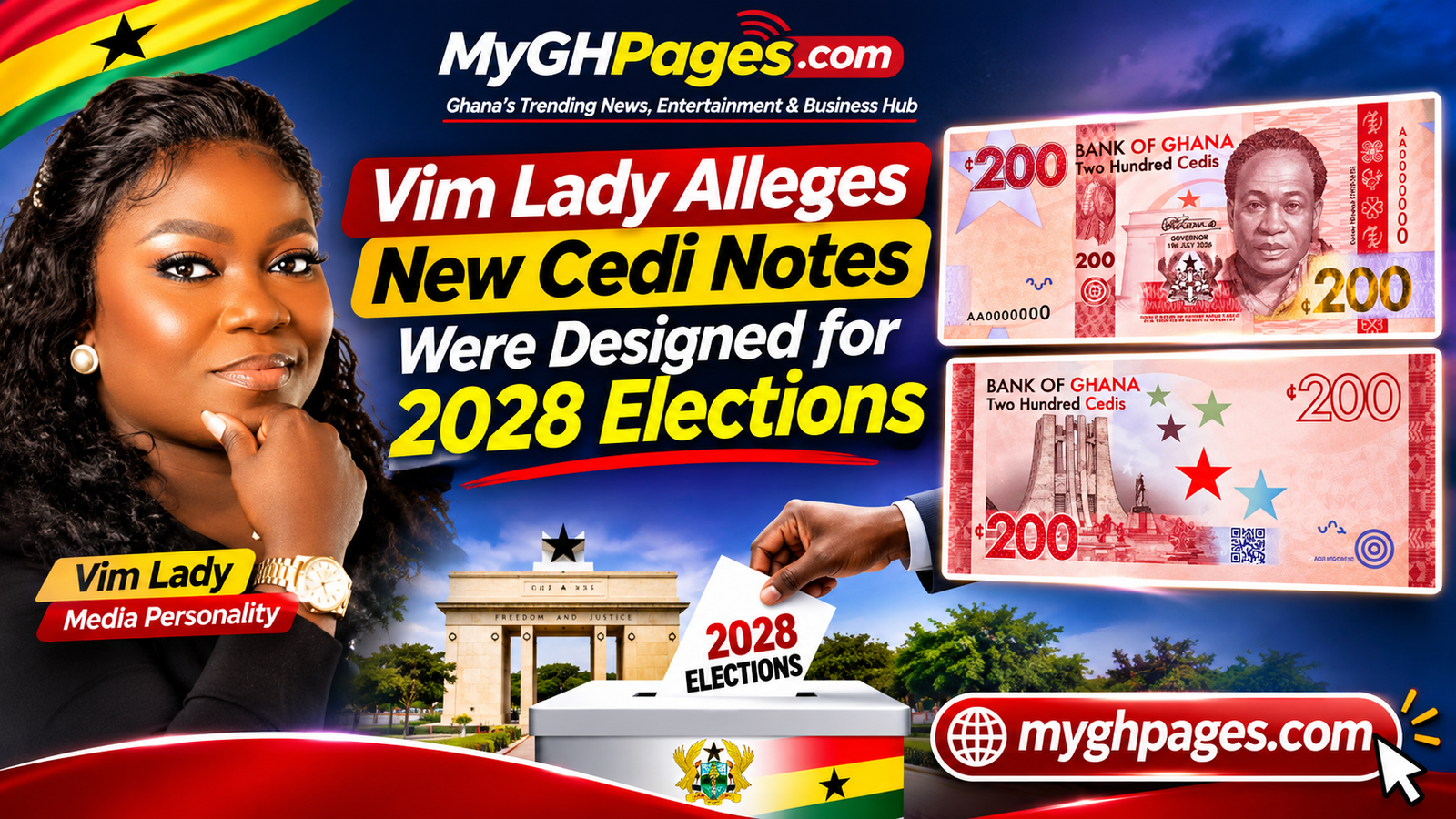
Vim Lady has questioned the timing of Ghana's new Heritage Series banknotes, alleging a possible connection to the 2028 elections.
‘They Designed New Currency for 2028 Elections’ – Vim Lady Questions Ghana’s New Cedi Notes
Media personality Vim Lady has sparked public debate after questioning the timing and economic implications of Ghana’s newly redesigned cedi banknotes, alleging that the exercise could be connected to political interests ahead of the 2028 general elections.
In a video shared on social media on November 16, 2026, Vim Lady criticised the government’s decision to introduce the redesigned banknotes, arguing that the process appeared rushed and lacked sufficient economic consideration.
She suggested that the timing of the currency redesign raised questions about the government’s priorities, particularly as Ghana approaches another election cycle and prepares for the next phase of its economic recovery.
Her comments have generated discussion about the cost of currency redesign, monetary policy, inflation, public spending and the responsibility of political leaders to protect the country’s economic stability.
Vim Lady alleges political motivation behind new cedi notes.
In her social media commentary, Vim Lady argued that the decision to introduce the redesigned banknotes was not necessarily driven by a desire to establish a lasting national legacy.
Instead, she alleged that the exercise could be connected to preparations for the 2028 general elections.
“The eagerness to design a new currency has nothing to do with legacy. The key thing is that they designed a new currency for the 2028 elections,” she stated.
She further warned that the decision could have implications for inflation, expressing concern that the economic consequences might become more visible in the coming years.
Vim Lady also criticised both the National Democratic Congress (NDC) and the New Patriotic Party (NPP), arguing that politicians should pay greater attention to the long-term economic effects of their decisions rather than focusing primarily on political considerations.
However, her allegation about an electoral motive has not been independently established. No evidence has been presented in the available material to demonstrate that the Bank of Ghana’s currency redesign was undertaken to finance or influence the 2028 elections.
Why is Vim Lady questioning the timing of the currency redesign?
One of the major issues raised by Vim Lady is the timing of the exercise.
She argued that introducing redesigned banknotes requires careful planning, research and public consultation, particularly in an economy that has recently experienced significant inflationary and currency pressures.
Comparing Ghana with Germany, the United Kingdom and the United States, she suggested that major changes to national banknotes should not be treated as routine political decisions.
She maintained that countries with established financial systems generally approach currency changes with considerable caution.
Vim Lady also questioned whether sufficient research had been conducted before the decision was taken, especially given Ghana’s economic commitments under its International Monetary Fund-supported programme.
Her argument raises a broader question about how central banks should balance the need to modernise physical currency with the economic and financial conditions of the country.
What the Bank of Ghana says about the Heritage Series
While Vim Lady has questioned the motives behind the exercise, the Bank of Ghana has publicly explained that the redesigned banknotes are intended to improve currency security, durability and efficiency.
The Central Bank announced the Heritage Series in September 2026, describing it as an upgraded version of Ghana’s existing banknotes.
According to the Bank, the core banknote designs had been in circulation for more than two decades. During that period, technology, security requirements and the demands of currency management had evolved.
The Heritage Series therefore incorporates enhanced security features, improved durability and modern designs intended to reflect Ghana’s history, culture and national identity.
The Bank has also explained that the new notes are produced using reinforced cotton paper, which is expected to improve their lifespan under frequent circulation.
President John Dramani Mahama officially launched the redesigned banknotes on November 12, 2026, at the Bank of Ghana headquarters in Accra.
The upgraded series is scheduled to enter circulation on December 1, 2026.
Importantly, the introduction of the Heritage Series does not mean Ghana is changing its national currency or immediately withdrawing all existing banknotes. The redesigned notes will circulate alongside the current series during a gradual transition.
This distinction is important because the exercise involves upgrading the existing cedi banknotes rather than introducing a completely different currency.
Will redesigned banknotes increase inflation in Ghana?
Vim Lady has warned that the currency redesign could have negative consequences for inflation.
Her concern comes at a time when households, traders, businesses and investors remain interested in the direction of Ghana’s economy and the purchasing power of the cedi.
However, the introduction of redesigned banknotes does not automatically cause inflation.
Inflation is influenced by several economic factors, including money supply, demand, production costs, exchange-rate movements, government spending, monetary policy and expectations about future prices.
A banknote redesign can involve production, distribution and currency-management costs, but determining its effect on inflation requires economic evidence.
The critical issue is whether the exercise is properly managed, how it is financed and whether currency issuance remains consistent with the Bank of Ghana’s monetary policy objectives.
For that reason, Vim Lady’s prediction should be understood as her warning and economic opinion rather than an established forecast.
The Bank of Ghana’s monetary policy decisions, inflation reports and money-supply statistics will be important indicators for assessing the economy’s performance as the new banknotes enter circulation.
IMF programme and concerns about Ghana’s economic outlook in 2027
Another important part of Vim Lady’s argument concerns Ghana’s economic outlook after the current IMF-supported programme.
She suggested that the country could experience financial difficulties in 2027 and argued that political leaders should be preparing for the economic challenges that might emerge after the programme period.
Her comments reflect wider public interest in whether Ghana can maintain economic stability, fiscal discipline and investor confidence beyond the period of IMF-supported reforms.
The IMF programme is not a substitute for Ghana’s own economic policies. Its longer-term impact depends on the country’s ability to maintain responsible public spending, strengthen revenue mobilisation, improve debt management and support sustainable economic growth.
The government and relevant institutions will therefore face important questions about how economic stability can be maintained after the programme period.
Vim Lady believes that politicians understand these challenges and are already considering their implications for the 2028 elections. However, her suggestion that the redesigned banknotes are intended to address possible election-related financial pressures remains an allegation, not an established fact.
Lessons from Ghana’s 2007 cedi redenomination
Vim Lady also referred to the cedi redenomination introduced under former President John Agyekum Kufuor in 2007.
During that exercise, four old cedi units were converted into one new Ghana cedi, effectively removing four zeros from the currency.
The redenomination was intended to simplify financial transactions, make accounting easier and restore confidence in the local currency.
Vim Lady argued that political leaders should examine the experience of that period before introducing major currency-related changes.
She recalled that the NPP government promoted the redenomination as an economic achievement but failed to secure another electoral victory in the 2008 general elections.
Her comparison highlights an important distinction between economic policy and political popularity: The introduction of a new banknote design does not automatically guarantee improved living standards or electoral support.
It is also important to distinguish the 2007 redenomination from the current Heritage Series. The 2007 exercise changed the unit of account by removing zeros, whereas the 2026 Heritage Series upgrades the design and security features of existing cedi denominations.
What Ghanaians should watch as the new notes enter circulation
As the December 1 introduction approaches, several issues will be important for the public and the business community.
1. The cost of the redesign
The public deserves transparent information about the cost of producing and distributing the upgraded banknotes and how the exercise will be managed.
2. Inflation and monetary discipline
The Bank of Ghana will need to maintain credible monetary policy and communicate clearly about the relationship between currency management, money supply and inflation.
3. Security against counterfeiting
The enhanced security features should make it easier for businesses and individuals to identify genuine banknotes and reduce the risk of counterfeit currency.
4. Public education
Banks, traders, transport operators and ordinary consumers need clear information about the new notes, their security features and the transition arrangements.
5. Continued use of existing notes
The Central Bank has stated that the existing banknotes will remain legal tender during the transition, allowing the public to adjust without being forced into an immediate exchange.
These issues will help determine whether the Heritage Series delivers the practical improvements promised by the Bank of Ghana.
A debate about economic priorities and political accountability
Vim Lady’s comments have brought renewed attention to the relationship between monetary policy, political decision-making and public confidence in Ghana’s economy.
While her allegation that the redesigned banknotes were prepared for the 2028 elections has not been substantiated, her criticism raises questions that deserve transparent answers from the relevant authorities.
The Bank of Ghana has presented the Heritage Series as a currency-modernisation exercise focused on security, durability and national heritage. The public will ultimately judge the initiative by its implementation, transparency and practical benefits.
As Ghana moves towards the 2028 general elections, economic management, inflation, government spending and the stability of the cedi are likely to remain important issues for voters.
Whether the new banknotes become a lasting improvement to Ghana’s currency system will depend not simply on their appearance, but on the strength of the economic policies and institutions supporting them.