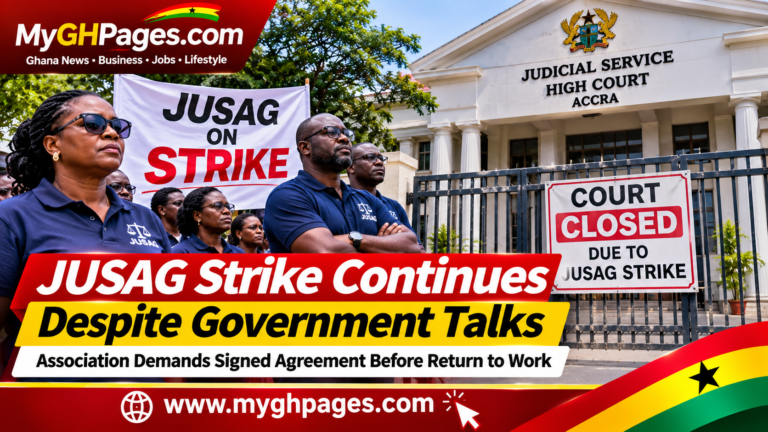
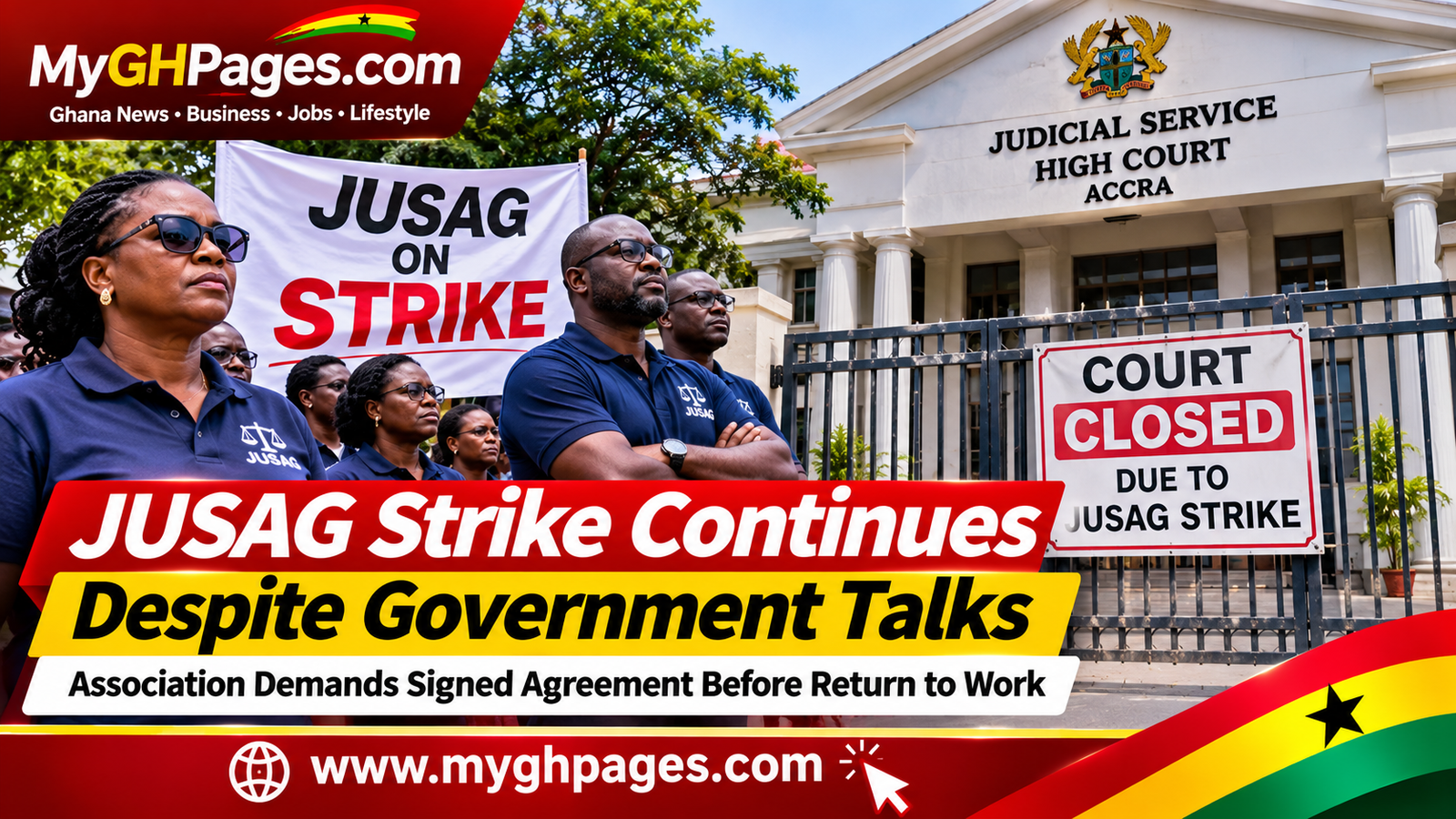
JUSAG says the nationwide strike will continue until the proposed agreement is formally signed and implementation begins
JUSAG Strike Continues Despite Government Talks as Association Demands Signed Agreement
The nationwide strike by the Judicial Service Staff Association of Ghana (JUSAG) remained in force on Tuesday, November 3, despite renewed discussions between the association and the government aimed at resolving the dispute over workers’ salaries and allowances.
The latest development followed a meeting between Labour Minister Emmanuel Kwadwo Agyekum and representatives of the association. The minister appealed to the workers to suspend their industrial action after discussions produced what he described as progress towards an agreement.
However, JUSAG has maintained that its members will not return to work until the proposed agreement is formally signed and the necessary implementation steps begin.
The disagreement has left court users across Ghana facing uncertainty over scheduled hearings, administrative services and other judicial processes.
Government and JUSAG hold fresh discussions.
The meeting on Tuesday was part of efforts to resolve the industrial dispute, which began on Monday, November 2.
Speaking after the discussions, the Labour minister described the engagement as positive and appealed to the association to reconsider its decision to continue the strike.
The government’s position is that dialogue can produce a solution and help restore normal operations within the Judicial Service.
However, JUSAG President Samuel Afotey Otu indicated that the association needed more than verbal assurances before suspending the action.
He said the workers were waiting for the formal approval and signing of the document discussed during the negotiations.
The association’s position is that an agreement must be properly documented and its implementation made clear before members can be directed to resume work.
This means that although the latest meeting represents progress in negotiations, it has not yet brought the industrial action to an end.
Why did JUSAG declare the strike?
JUSAG declared an indefinite nationwide strike over delays in approving and implementing the 2026 salary review and related allowances for judicial service employees.
The association says it has been pursuing the matter for several months and that previous engagements did not produce the outcome it expected.
According to the association, its demands relate to the applicable conditions of service and the need to implement the revised salary arrangements.
JUSAG has also raised concerns about outstanding salary arrears covering January to October 2026.
The association argues that the salary review process should comply with the relevant legal and administrative framework governing judicial service employees.
Its leadership has insisted that the workers should receive the approved revised conditions of service and that outstanding issues must be addressed before the strike can be called off.
Court activities are affected across the country.
The industrial action has disrupted activities at several court premises, affecting litigants, lawyers, court staff and members of the public who depend on the judicial system.
Reports from different parts of the country have described closed court premises and interruptions to scheduled proceedings.
People who had expected to attend hearings or complete administrative processes have faced uncertainty over whether their matters could proceed.
The disruption is particularly concerning for individuals involved in cases where delays may have serious consequences.
These include people awaiting bail decisions, accused persons in custody, parties involved in civil disputes and individuals seeking urgent legal remedies.
The Judicial Service has acknowledged the inconvenience caused by the strike and appealed to the public, lawyers and court users to exercise patience while management engages the relevant government institutions.
The Supreme Court sits despite the industrial action.
Although several court facilities experienced disruption, the Supreme Court proceeded with its scheduled sitting on Tuesday, November 3.
A five-member panel heard cases, with lawyers and members of the public present in the courtroom.
The sitting followed a directive from Chief Justice Paul Baffoe-Bonnie, communicated through a notice issued by the Judicial Service.
The decision ensured that the country’s highest court continued its scheduled business despite the wider industrial action.
The Chief Justice has also reaffirmed the Judicial Service’s commitment to restoring full court operations as soon as possible.
The Supreme Court’s sitting should not, however, be interpreted as an end to the strike. JUSAG’s industrial action remained in force, and disruptions continued to affect other parts of the judicial system.
What the dispute means for ordinary Ghanaians
The strike is not simply an internal disagreement over employment conditions. Its effects extend to people who need access to the justice system.
When court proceedings are delayed, individuals may have to wait longer for decisions involving family matters, property disputes, commercial disagreements and criminal cases.
Businesses can also experience uncertainty when legal proceedings involving contracts, debts or other commercial matters are postponed.
For people who travel long distances to attend court, a cancelled or postponed hearing may mean additional transport costs, lost working hours and further financial pressure.
The situation also highlights the importance of ensuring that essential public institutions can continue delivering services during industrial disputes.
While workers have the right to raise concerns about their employment conditions, prolonged disruption can place additional pressure on citizens who have no direct involvement in the disagreement.
Why a signed agreement matters
JUSAG’s insistence on a signed agreement reflects its concern that promises made during negotiations must translate into an enforceable and practical arrangement.
In labour disputes, an agreement needs to establish what has been accepted by both sides, the obligations of the parties and the steps required to implement the settlement.
For the association, formal documentation is important because members need clarity about their revised conditions of service, salary arrangements and outstanding payments.
The government, on the other hand, must ensure that any commitments are consistent with the relevant approval and payment processes.
The immediate challenge is therefore to move from discussions to a documented settlement that both parties are prepared to honour.
Until that happens, uncertainty over the resumption of normal court operations is likely to remain.
What happens next?
The key issue is whether the government and JUSAG can finalise and sign the proposed agreement and establish a clear implementation timetable.
The Labour Minister has appealed for the suspension of the strike, but the association’s leadership has made it clear that members are awaiting the formal document.
The Judicial Service management has also been engaging relevant government stakeholders and has expressed its desire to restore normal operations.
For now, Ghanaians who have pending court cases should confirm the status of their hearings directly with the relevant court registry or through their lawyers rather than assuming that every court is operating normally.
People with urgent legal matters should seek guidance from their legal representatives about the available procedures.
A resolution is needed to restore public confidence.
The JUSAG dispute has placed the government’s labour relations efforts and the Judicial Service’s ability to maintain uninterrupted operations under public scrutiny.
A lasting solution will require more than an appeal to workers to return to their posts. It will require clear commitments, proper documentation and timely implementation.
The association wants its outstanding employment concerns addressed, while the public needs a functioning justice system that can handle cases without unnecessary delays.
The latest negotiations offer an opportunity to resolve the disagreement, but the outcome will depend on whether both sides can complete the formal steps required to bring the strike to an end.
GhanaGossips will continue monitoring the negotiations and report confirmed updates on the resumption of court operations.
This report reflects developments available on November 3, 2026. The strike status and implementation arrangements may change as negotiations continue.
Sources checked
-
Ghana News Agency — Supreme Court resumes sittings amid nationwide JUSAG strike — November 3, 2026.
-
Graphic Online — JUSAG strike halts court proceedings nationwide — November 3, 2026.