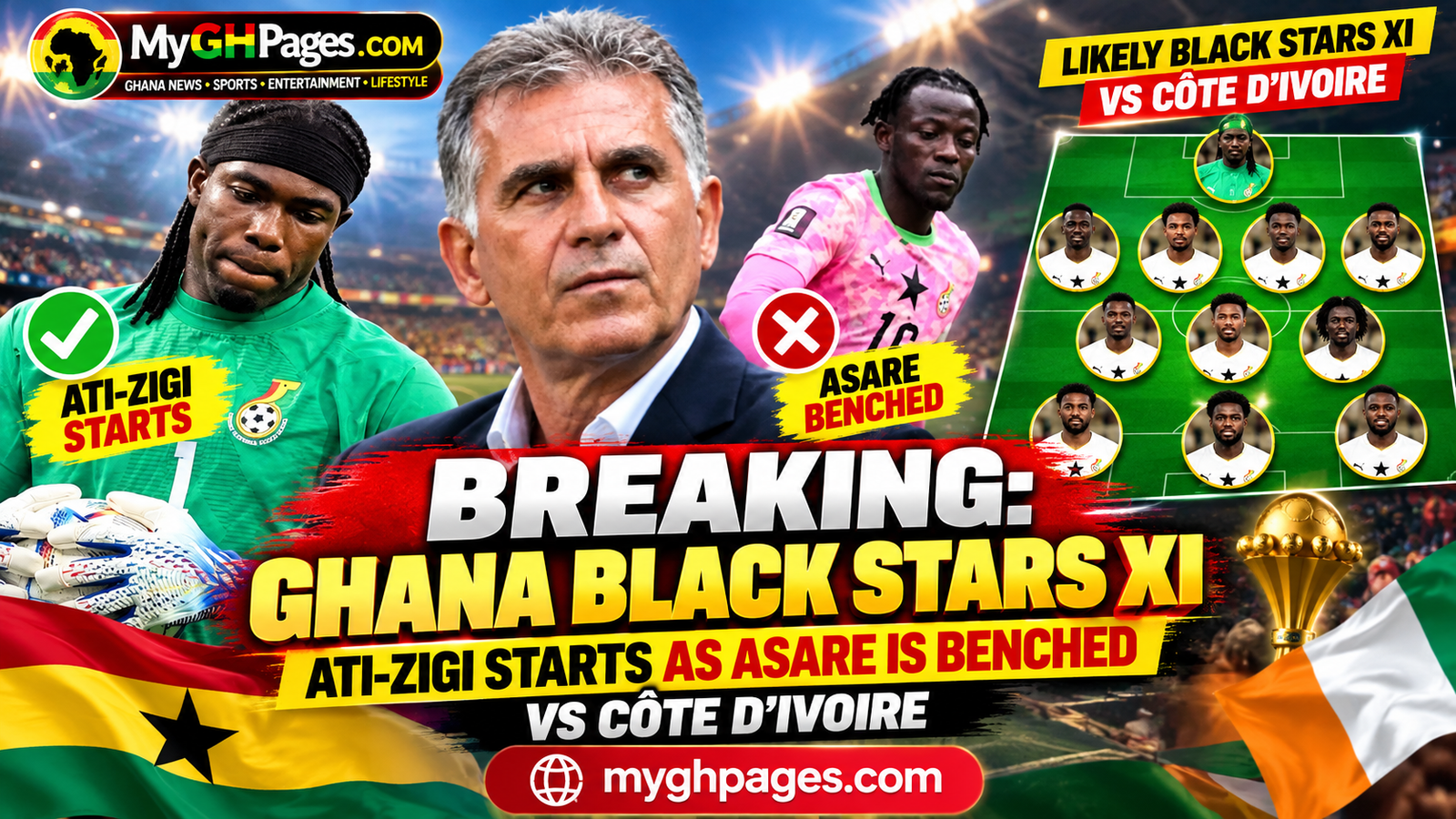
Ghana Black Stars XI prepares for the crucial AFCON qualifier against Côte d’Ivoire.
Breaking: Asare Benched? Ati-Zigi Set for Ghana’s Likely XI Against Côte d’Ivoire
Ghana begin their 2027 Africa Cup of Nations (AFCON) qualification campaign against Côte d’Ivoire in Bouaké on Thursday, September 24, 2026, with head coach Carlos Queiroz facing an immediate selection challenge after a series of withdrawals from the Black Stars squad.
The much-anticipated West African encounter will be played at the Stade de la Paix, with kick-off scheduled for 19:00 GMT. The match is Ghana’s opening Group C fixture in the race to qualify for the 2027 AFCON finals in Kenya, Tanzania and Uganda. (Confédération Africaine de Football)
The latest squad developments have changed the selection picture considerably since Queiroz initially named his team. Several established players are now unavailable, including Mohammed Kudus, Antoine Semenyo, Jordan Ayew, Baba Rahman and Nathaniel Adjei, while other players have also been affected by medical concerns. (The Independent Ghana)
That has increased attention on the players who remain available and could receive the responsibility of starting Ghana’s first competitive match of the new AFCON qualification cycle.
One of the biggest questions remains in the goal.
Benjamin Asare was part of Ghana’s 2026 FIFA World Cup squad and remains one of the three goalkeepers selected by Queiroz. However, Lawrence Ati-Zigi is also available and has considerable international experience. The expectation in the report being discussed is that Ati-Zigi could start ahead of Asare.
Importantly, however, the official starting XI will only be confirmed when the team sheets are released before kick-off.
Ghana Black Stars XI vs Côte d’Ivoire: Who Will Start?
The goalkeeper position has become one of the most closely watched selection battles within the Black Stars. The Ghana Black Stars XI will be one of the biggest talking points ahead of the crucial AFCON qualifier, particularly because several regular starters are unavailable.
Benjamin Asare has established himself as a serious option for Ghana and was included in Queiroz’s original 24-man squad alongside Lawrence Ati-Zigi and Joseph Anang. The Ghana Football Association confirmed that all three goalkeepers were part of the initial selection for the September international window. (Ghana Football Association) The Ghana Black Stars XI could see Lawrence Ati-Zigi take the goalkeeper position, with Benjamin Asare potentially beginning the match on the bench.
Ati-Zigi, meanwhile, brings international experience and familiarity with the Black Stars setup. His ability to organise the defence, distribute from the back and handle high-pressure matches makes him a natural candidate for an away qualifier of this magnitude.
The reported expectation that Ati-Zigi could start does not necessarily mean Asare has been dropped from Queiroz’s plans. Instead, it could simply reflect the coach’s assessment of the particular opponent, match conditions and tactical requirements.
Côte d’Ivoire present a significant attacking threat, and Ghana will need a goalkeeper capable of making important saves while also remaining composed when the hosts apply pressure.
For more Ghana football news and Black Stars updates, readers can also follow the latest sports stories on MyGHPages.
The decision in goal could ultimately come down to experience, current training performance and Queiroz’s preferred tactical approach.
Ghana’s Defence Faces an Early Test
The defensive line is another important area for Queiroz.
The original selection included Alexander Djiku, Jerome Opoku, Gideon Mensah, Kojo Oppong Peprah, Baba Rahman, Nathaniel Adjei, Derrick Luckassen, Jan Gyamerah and other options. The defensive structure of the Ghana Black Stars XI will also be closely watched as Carlos Queiroz looks for the right combination against Côte d’Ivoire.
However, the withdrawals have changed the available defensive combinations. Baba Rahman and Nathaniel Adjei are among those reported unavailable, while Alidu Seidu has also become unavailable after initially being brought into the squad as an additional option. (The Independent Ghana)
That makes the remaining defenders even more important.
Alexander Djiku is expected to provide leadership and experience in the centre of defence. His ability to read the game and compete physically could be important against Côte d’Ivoire’s forwards.
Jerome Opoku is another player who could be trusted in the heart of the defence. His performances at the international level have given him additional credibility within the national team setup.
The possibility of Djiku and Opoku forming the central defensive partnership would give Ghana a combination of experience and athleticism.
The full-back positions are less straightforward because the original squad has also been affected by withdrawals. Gideon Mensah remains an important option, while Queiroz has additional players available following the changes to the squad.
Ghana will need its full-backs to perform two jobs simultaneously.
Defensively, they must prevent Côte d’Ivoire from exploiting wide areas. Offensively, they will need to provide width and support Ghana’s attacking players.
That balance could be crucial because the Black Stars are expected to spend periods defending without the ball, particularly during the opening stages of the match.
The Midfield Could Decide the Match
The midfield selected for the Ghana Black Stars XI could determine how effectively Ghana controls possession and handles pressure from the hosts. The midfield battle is likely to be one of the most important tactical areas in Bouaké.
Ghana’s original squad included Kwasi Sibo, Caleb Yirenkyi, Augustine Boakye, Ronald Donkor and Ibrahim Sulemana, among others. Rahim Ibrahim was later added as part of the changes made following the withdrawals.
With several senior players unavailable, Queiroz may be forced to rely on a midfield combination that have had limited time together at the international level. (The Independent Ghana)
Kwasi Sibo could provide physical strength and defensive discipline, while Caleb Yirenkyi offers another option for progressing the ball and supporting the attacking transition.
Rahim Ibrahim has also attracted attention after receiving an opportunity within the reshaped Black Stars squad.
For Ghana, the midfield cannot afford to become disconnected from the defence and attack.
If the midfield is too deep, the forwards could become isolated. If the midfield pushes too aggressively forward, Côte d’Ivoire could exploit spaces behind them.
The financial and commercial side of modern football also makes midfield performance increasingly important. International matches influence sponsorship exposure, broadcast value, player visibility and professional opportunities. A strong performance in a major African qualifier can increase attention around players and potentially affect their market value.
That does not mean individual players should focus on commercial considerations during the match. Their immediate task is tactical: maintain possession when possible, protect the defence and create opportunities for the forwards.
Fatawu Issahaku Could Carry More Attacking Responsibility
With several established forwards unavailable, the attacking players included in the Ghana Black Stars XI will have greater responsibility to create scoring opportunities. With Mohammed Kudus, Antoine Semenyo and Jordan Ayew unavailable, Ghana’s attacking structure has been significantly affected.
Kudus withdrew to continue his recovery and build his fitness following a lengthy injury absence. Semenyo is also unavailable after a physical issue, while Captain Jordan Ayew was ruled out after a medical assessment detected an injury. (The Independent Ghana)
These absences mean Abdul Fatawu Issahaku could become one of the most important attacking players available to Queiroz.
Fatawu possesses pace, direct running ability and the confidence to take on defenders. Against Côte d’Ivoire, his ability to transition quickly from defence into attack could be particularly valuable.
Ghana may not dominate possession for the entire match, meaning the team could need forwards who can exploit space during counter-attacking situations.
Fatawu can potentially perform that role.
His movement from the flank can also create opportunities for another forward to attack the penalty area.
For Ghana to produce a positive result, the attacking players will need to make their limited opportunities count.
Ernest Nuamah Could Become a Key Outlet
Ernest Nuamah is another player who could receive greater attacking responsibility.
The absence of several established forwards means Nuamah may have to operate as one of the main outlets for Ghana’s attack.
His pace can create problems for defenders, particularly when Ghana wins possession and immediately looks to move forward.
A potential combination involving Nuamah and Fatawu could provide Queiroz with two players capable of stretching the Ivorian defence.
Rather than building attacks exclusively through the middle, Ghana could look to use the wings to create space.
That could also help the midfield because wide attacking movements can force opposing defenders to move away from central positions.
The success of this approach will depend heavily on how quickly Ghana can transition after recovering possession.
The Centre-Forward Position Is Now a Major Question
The centre-forward position has become much more uncertain following Prince Kwabena Adu’s withdrawal.
Adu was originally selected by Queiroz but became unavailable after suffering a head injury while playing for Viktoria Plzeň. (The Independent Ghana)
That means the original proposed XI featuring Adu at centre-forward needs to be adjusted.
Brandon Thomas-Asante, Felix Afena-Gyan, Mohammed Fuseini, Benjamin Tetteh and other attacking options have been brought into the wider squad following the withdrawals.
This gives Queiroz several possibilities.
He could select a conventional centre-forward or use a more flexible attacking system in which the forwards interchange positions.
Against a strong Côte d’Ivoire side, movement could be particularly important.
A striker who can hold the ball up would allow Ghana’s midfielders to move forward. A faster forward could instead allow the Black Stars to exploit space behind the Ivorian defence.
The final decision will depend on Queiroz’s assessment of the opponent and the players’ physical condition.
Why the 4-3-3 Formation Remains Possible
A 4-3-3 system remains one of the logical tactical options for Ghana.
The formation allows three midfielders to provide defensive protection while giving the wide forwards freedom to attack.
With players such as Fatawu Issahaku and Ernest Nuamah available, the system could allow Ghana to exploit the wings.
The three-man midfield could also help protect the centre of the pitch.
However, Queiroz could adjust the formation during the match.
If Ghana needs greater defensive stability, the shape could become more compact. If the Black Stars need a goal, additional attacking players could be introduced.
Modern football increasingly requires coaches to manage games rather than simply select one formation and maintain it for 90 minutes.
That could be especially important in a high-pressure AFCON qualifier.
Côte d’Ivoire Presents a Major Opening Challenge
Ghana could hardly have asked for an easier opening fixture.
Côte d’Ivoire are one of Africa’s major football nations and will have home advantage in Bouaké.
CAF has described the Côte d’Ivoire-Ghana fixture as one of the headline matches of the opening round of the 2027 AFCON qualifiers. (Confédération Africaine de Football)
The match also carries importance because Ghana and Côte d’Ivoire are both in Group C alongside The Gambia and Somalia.
The qualification format requires teams to finish strongly within their groups, making every point valuable.
Ghana’s next Group C fixture will be against The Gambia in Accra on September 29.
That means Queiroz and his technical team will be thinking beyond the first 90 minutes. Player workload, injury management and squad rotation could all become important during the international window.
Ghana’s Injury Problems Have Changed the Selection Picture
The biggest difference between the original predicted XI and the current situation is the number of withdrawals.
Mohammed Kudus, Antoine Semenyo and Jordan Ayew are among the most significant absentees. Baba Rahman, Nathaniel Adjei, Alidu Seidu and Prince Kwabena Adu have also been affected by unavailability. (The Independent Ghana)
GFA president Kurt Okraku has said the withdrawals are primarily connected to injuries and medical concerns and has rejected suggestions that players deliberately avoided national-team duty. (Pulse Ghana)
The situation means Queiroz has had to adjust his squad shortly before the qualifier.
That creates an opportunity for less-established players.
For young footballers, a major international fixture can become an important career moment. A strong performance can increase visibility among clubs, scouts, sponsors and football decision-makers.
The same match can also provide valuable data for coaching staff through performance analytics, including passing accuracy, progressive carries, defensive actions, distance covered and attacking efficiency.
The Black Stars Need Tactical Discipline
With several key players missing, Ghana may need to compensate through organisation.
The Black Stars cannot afford unnecessary gaps between their defensive and midfield lines.
Against a team with quality attackers, losing possession in dangerous areas can create immediate problems.
Ghana’s midfielders will therefore have to understand when to press and when to maintain their defensive shape.
The forwards will also have defensive responsibilities.
Fatawu and Nuamah, for example, may be expected to track opposing full-backs when Ghana does not have possession. That can reduce the pressure on the defenders and make it harder for Côte d’Ivoire to build attacks from wide areas.
The goalkeeper will also have an important role in organising the defensive structure.
Whether Ati-Zigi or Asare starts, communication between the goalkeeper and central defenders will be critical.
What the Goalkeeper Decision Could Mean
The reported possibility of Ati-Zigi starting ahead of Asare is one of the most interesting selection developments before kick-off.
Asare has demonstrated that he belongs in the conversation for the national-team position, while Ati-Zigi has a longer history of international involvement.
Queiroz therefore has two credible options.
If Ati-Zigi starts, Asare could remain an important alternative from the bench and continue competing for future matches.
If Asare starts, it would signal that the coach is prepared to trust the goalkeeper in a major away qualifier.
Either way, the decision should not be interpreted as a permanent ranking of Ghana’s goalkeepers.
Football selection is match-specific, and coaches regularly rotate players based on tactical requirements, form, fitness and opposition.
The Commercial Importance of AFCON Qualification
The AFCON qualification campaign is also significant beyond the sporting aspect.
International football generates substantial attention across television, radio, digital media, sponsorship, advertising and ticketing.
Ghana’s Black Stars are one of the country’s strongest sports brands, meaning major competitive fixtures attract substantial interest from fans and commercial partners.
A successful qualification campaign can increase media exposure and create more opportunities for sponsors and broadcasters.
Player performances can also affect market valuations and future transfer opportunities, particularly for younger members of the squad.
For sports publishers, Black Stars fixtures generate strong search interest around match previews, starting lineups, live scores, player statistics, team news and post-match analysis.
Readers interested in the business side of Ghanaian football can also explore the Ghana football development and FIFA funding story on MyGHPages.
Betting Interest Will Also Be High
Major AFCON qualifiers naturally attract significant interest from football supporters and sports betting audiences.
Search activity around Ghana vs Côte d’Ivoire is likely to include terms such as Ghana vs Côte d’Ivoire predictions, Black Stars lineup, AFCON qualifiers, match odds, team news, player statistics and live score updates.
However, match predictions and betting markets should be treated separately from confirmed team information.
The starting XI should not be described as official until the team sheets are released.
For publishers covering sports betting, responsible language is also important. Odds can change rapidly, and no prediction can guarantee a particular result.
MyGHPages has previously covered the development of the sports betting industry in Ghana, including its connection with digital technology and football audiences. Readers can explore the site’s sports betting Ghana coverage.
The Likely Ghana XI Needs an Update
The original projected lineup listed Lawrence Ati-Zigi in goal, Alexander Djiku and Jerome Opoku in central defence, Kojo Oppong Peprah and Gideon Mensah at full-back, Caleb Yirenkyi, Kwasi Sibo and Rahim Ibrahim in midfield, Ernest Nuamah and Fatawu Issahaku on the wings, and Prince Kwabena Adu as the centre-forward.
But that prediction requires an important correction because Prince Kwabena Adu is now unavailable.
The same applies to other players whose circumstances have changed since the original projection.
Based on the currently reported availability and the selection scenario, Ati-Zigi remains a possible goalkeeper, while Djiku, Opoku, Mensah and Oppong Peprah remain among the defensive candidates.
Yirenkyi, Sibo and Rahim Ibrahim could form a midfield combination, although Queiroz has several other midfield options.
Nuamah and Fatawu remain logical attacking candidates, while the centre-forward position is now one of the biggest unresolved questions.
Therefore, rather than treating the original XI as confirmed, it is more accurate to describe it as a pre-match projection subject to late changes.
A Possible Shape for Ghana
A possible 4-3-3 structure could see Ati-Zigi behind a defensive line featuring Djiku, Opoku, Mensah and Oppong Peprah.
Yirenkyi, Sibo and Rahim Ibrahim could form the midfield triangle, providing a mixture of ball recovery, distribution and forward support.
Nuamah and Fatawu could occupy the wide attacking positions.
The remaining question would be the central striker.
Because Prince Kwabena Adu is unavailable, Queiroz must decide whether to use another recognised striker or adjust the shape to accommodate a more mobile attacking player.
That decision could have a major influence on Ghana’s attacking approach.
The Importance of Rahim Ibrahim
Rahim Ibrahim is one of the players who could benefit from the reshaped squad.
The midfielder was among the additions made after the wave of withdrawals and has an opportunity to demonstrate that he can compete at the senior international level.
For a player in that position, the match presents both pressure and opportunity.
A disciplined performance against Côte d’Ivoire could enhance his standing within the national team and potentially influence future selection decisions.
The same applies to the other players brought into the squad during the late changes.
Queiroz has repeatedly emphasised the need to deliver despite the limited preparation time. Reports indicate that he described the situation as having several problems to solve while insisting that Ghana must continue moving forward. (The Independent Ghana)
What Fans Should Watch for During the Match
One of the biggest tactical questions will be whether Ghana attempts to press Côte d’Ivoire high up the pitch or remains compact and looks for counter-attacking opportunities.
The second question will be how the midfield handles Côte d’Ivoire’s possession.
The third will be whether Ghana can create enough chances despite missing several established attackers.
The goalkeeper’s distribution will also be important.
If Ghana can move the ball quickly from defence into midfield, the Black Stars could create transition opportunities for Fatawu and Nuamah.
If Ghana struggles to progress the ball, the forwards could spend too much time defending and become isolated.
Queiroz Has Limited Time to Experiment
The biggest challenge for Carlos Queiroz is that this is not a friendly match.
It is the opening game of an important continental qualification campaign.
CAF confirmed that the first two matchdays of the 2027 AFCON qualifiers are being played between September 24 and October 6, with Ghana facing Côte d’Ivoire first and The Gambia five days later. (Confédération Africaine de Football)
That gives Queiroz very little room for experimentation.
The coach must balance the need to develop a new-look squad with the immediate requirement to compete for points.
Ghana’s failure to qualify for the 2025 AFCON finals has made the 2027 campaign particularly significant for supporters.
The Black Stars will therefore be under pressure to make their return to continental qualification count.
Ghana’s Road After Côte d’Ivoire
After the trip to Bouaké, Ghana, I will return home to face The Gambia on September 29. The projected Ghana Black Stars XI could feature a mixture of experienced internationals and players looking to establish themselves under Carlos Queiroz.
The Black Stars will then travel to Morocco for an international friendly against the Atlas Lions on October 4.
That three-match schedule gives Queiroz an opportunity to evaluate his squad across competitive and friendly football.
The Côte d’Ivoire match will provide the strongest immediate test, while the subsequent fixtures could give additional opportunities to players who were introduced following the injury problems.
The coach will also hope that the players currently recovering from injuries return to full fitness for future qualification rounds.
Final Thoughts on the Predicted Black Stars XI
The most important point ahead of Ghana’s clash with Côte d’Ivoire is that the expected lineup should not be confused with the official team.
Ati-Zigi is reportedly expected to have an advantage over Benjamin Asare in the goalkeeping battle, but the final decision belongs to Carlos Queiroz.
Djiku and Opoku are possible central defensive options, while Mensah and Oppong Peprah are among the candidates for the full-back positions.
Sibo, Yirenkyi and Rahim Ibrahim could provide the midfield foundation, while Fatawu Issahaku and Ernest Nuamah could carry significant attacking responsibility.
The centre-forward position remains the most difficult to predict following the withdrawal of Prince Kwabena Adu.
Ghana enter the match without several high-profile players, but the reshaped squad gives other members of the Black Stars an opportunity to make a significant contribution.
The match is scheduled for 19:00 GMT on September 24, 2026, in Bouaké, and the official starting XI will ultimately settle the debate over Asare, Ati-Zigi and the rest of Queiroz’s selection. (Confédération Africaine de Football)
For more Black Stars news, Ghana football updates, AFCON coverage and sports business stories, readers can continue following the MyGHPages Sports section.
Sources
The squad and fixture information above has been cross-checked against the Ghana Football Association, CAF, Ghana News Agency and recent reports concerning the player withdrawals. (Ghana Football Association)
Other stories
-
SHOCKING: Florence Obinim Drops Surname and Reveals New Stage Name
-
Salamatu Karim Murder Case: Inside the Supreme Court Ruling on the Pokuase Killing
-
Latest Antoine Semenyo Withdrawal: What Ghana Fans Need to Know
-
10 Foods With More Vitamin C Than Oranges: Chilli Peppers and Other Powerful Sources
-
Auntie Bee: Facts About Her Fame, Acting Career and Financial Struggles
FAQ
Who is expected to start for Ghana against Côte d’Ivoire?
Lawrence Ati-Zigi is among the leading candidates to start in goal, although the official Ghana Black Stars XI will only be confirmed when the team sheet is released.
Will Benjamin Asare start against Côte d’Ivoire?
Benjamin Asare is a goalkeeper option for Ghana, but the current projection has Lawrence Ati-Zigi starting ahead of him.
What is Ghana’s likely formation?
Ghana could use a 4-3-3 formation, although Carlos Queiroz may change the tactical system depending on the opponent and match situation.
When is Ghana playing Côte d’Ivoire?
Ghana face Côte d’Ivoire on September 24, 2026, in the 2027 AFCON qualification campaign.
Who is Ghana’s coach?
Carlos Queiroz is the head coach of the Ghana Black Stars.
Is the Ghana Black Stars XI confirmed?
No. A predicted or likely XI should not be presented as official until Ghana’s team sheet is released.
Why are several Black Stars players missing?
Several Ghana players have reportedly withdrawn from the squad because of injuries and medical concerns, affecting the original selection options.
Where can fans get official Ghana team news?
Fans can check the Ghana Football Association and CAF for official competition information.