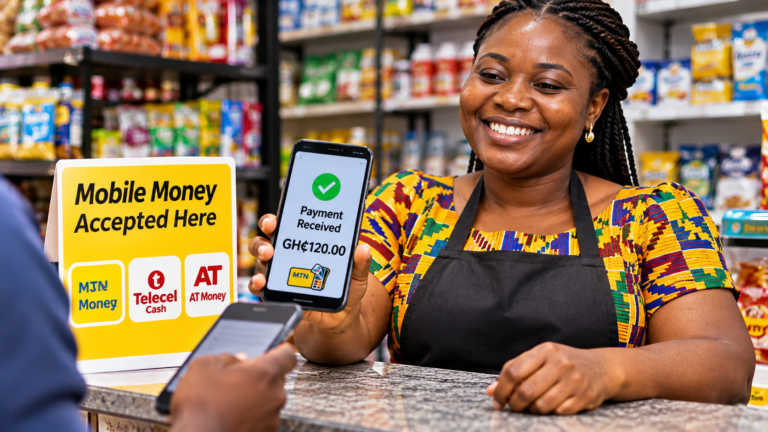
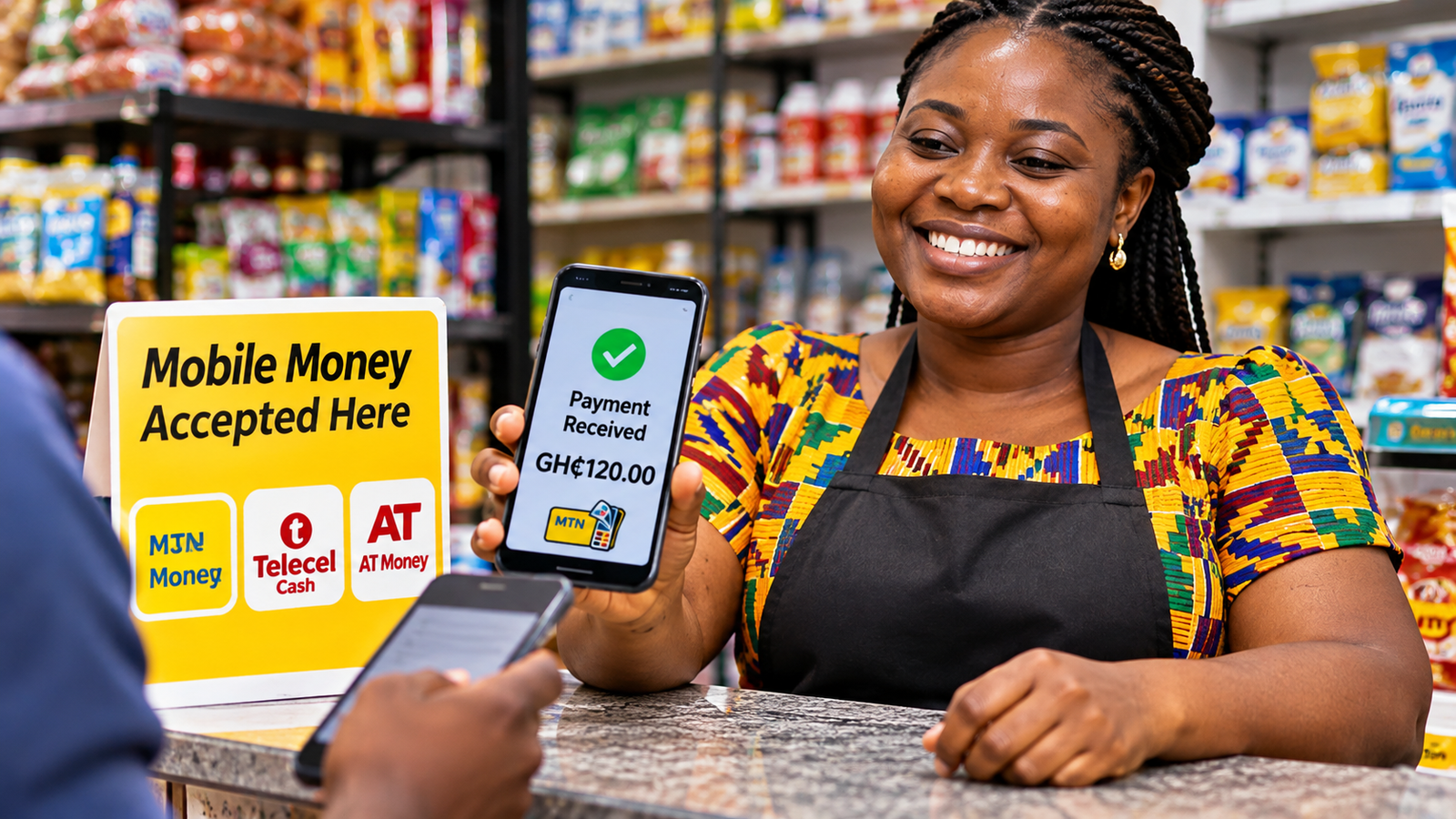
A Ghanaian small-business owner confirms a customer's mobile money payment.
How Ghanaian Small Businesses Can Build Customer Trust in Digital Payments
By MyGHPages Business Desk
Digital payments are changing the way Ghanaian small businesses sell products, receive money and interact with customers. From market traders and provision shops to restaurants, online retailers and service providers, more businesses are using mobile money, bank transfers, payment cards and digital payment platforms to make transactions easier.
However, offering customers a convenient way to pay is only one part of building a successful digital business. Customers must also feel confident that their money is going to the right account, their personal information is protected and their payments will be properly acknowledged.
For small businesses, customer trust can determine whether a buyer makes a second purchase, recommends the business to friends or chooses a competitor.
A customer who experiences an unexplained payment deduction, an unacknowledged transaction or poor complaint handling may become reluctant to use that business again.
This makes trust an important part of digital business management.
The Bank of Ghana recognises the importance of reliability, safety and security in building public confidence in digital payments. Its National Payment Systems Strategy 2025–2029 identifies trusted payment infrastructure, cybersecurity, fraud monitoring and consumer protection as important priorities.
For Ghanaian entrepreneurs, the message is clear: adopting digital payment technology must go hand in hand with transparency, security and responsible customer service.
1. Why Customer Trust Matters in Ghana’s Digital Payment Economy
Trust is one of the foundations of successful business relationships.
Customers want to know that when they transfer money for a product or service, the transaction will be completed correctly and the business will honour its responsibilities.
This becomes particularly important for online businesses where customers may pay before receiving their products.
Consider a customer ordering clothes from an online seller in Accra. The customer transfers GH¢350 through mobile money but receives no payment confirmation.
Even if the business has received the money, the lack of communication may create uncertainty.
The customer may begin wondering whether the seller is legitimate or whether the payment has disappeared.
A simple transaction confirmation, order reference and expected delivery time can prevent this situation.
For small businesses, trust can deliver several benefits:
- Increased customer confidence.
- More repeat purchases.
- Better online reviews and recommendations.
- Fewer payment disputes.
- Stronger business reputation.
- Improved customer retention.
- Greater willingness to purchase online.
Businesses that treat customer trust as part of their daily operations are better positioned to build lasting relationships.
2. Make Your Business Payment Information Clear and Transparent
One of the simplest ways to build trust is to make payment instructions easy to understand.
Customers should never have to guess where to send money, which account belongs to the business or how much they are expected to pay.
Every business accepting digital payments should clearly communicate its official payment information.
This includes:
- Registered or commonly recognised business name.
- Official merchant account or payment details.
- Business telephone number.
- Total amount payable.
- Delivery or service charges.
- Payment confirmation procedure.
- Refund and cancellation conditions.
- Customer support contact information.
For online sellers, this information should appear on the website, business social media pages or official order confirmation messages.
Businesses should also avoid changing payment numbers without proper communication.
If a payment account must change, customers should receive an announcement through established official channels.
A sudden WhatsApp message requesting payment to a new number should always be independently verified.
3. Use Official Merchant Accounts Instead of Confusing Customers
Businesses should establish clear payment channels that customers can recognise and verify.
Using an appropriately registered merchant payment arrangement can help create a more professional payment experience.
Depending on the provider, merchant services may offer transaction references, business payment records and settlement information.
These features can help separate business transactions from personal financial activities.
Small businesses should investigate the merchant services available from:
- MTN MobileMoney.
- Telecel Cash.
- AT Money.
- Participating commercial banks.
- Authorised payment service providers.
- Online payment gateway providers.
Before choosing a service, confirm the provider’s authorisation where applicable and obtain its current merchant charges and service conditions.
Businesses should avoid presenting an employee’s personal wallet as the official company payment account without a proper internal arrangement.
A consistent payment identity helps customers recognise the business and reduces confusion.
4. Always Confirm Payments Before Processing Orders
Payment confirmation is one of the most important trust-building procedures for digital businesses.
A business should never rely exclusively on screenshots or payment messages supplied by customers.
Fraudsters can manipulate screenshots, edit notifications or send messages designed to resemble genuine transaction alerts.
A better approach is to verify each transaction using the official merchant application, provider dashboard or account transaction history.
For example, an online shop receiving a GH¢500 order should:
- Check the actual merchant account.
- Confirm that the payment has been received.
- Verify the transaction reference.
- Match the payment against the customer’s order.
- Send an official payment confirmation.
- Process the order according to the agreed delivery arrangements.
This procedure protects the business while reassuring customers that their payments are being handled professionally.
Businesses should also train employees not to release goods simply because a customer displays a screenshot.
5. Protect Customers’ Personal and Financial Information
Digital payments require businesses to handle certain customer information, including names, telephone numbers, transaction references and order details.
Some businesses may also collect delivery addresses, email addresses and other personal information.
This information must be handled responsibly.
The Payment Systems and Services Act, 2019 (Act 987), establishes consumer protection principles for electronic money issuers and payment service providers. These include protecting customer privacy, personal details, financial information and transaction data.
Although small businesses may not be directly regulated as payment service providers, they should still take appropriate care when collecting and handling customer information.
Practical measures include:
- Collect only information needed to complete the transaction.
- Restrict access to customer records.
- Avoid sharing customer telephone numbers without permission.
- Do not request unnecessary bank details or mobile money PINs.
- Use secure devices and password-protected accounts.
- Avoid keeping sensitive customer information in publicly accessible spreadsheets.
- Delete information when it is no longer required, subject to applicable record-keeping obligations.
Businesses should also provide customers with clear information about how their details are used.
Protecting personal information is not only a security measure; it is also an important part of professional customer service.
6. Make Refunds and Payment Disputes Easy to Understand
Payment problems can happen even when a business operates honestly.
A transaction may fail, a customer may transfer the wrong amount or an order may need to be cancelled.
What matters is how the business responds.
Customers lose confidence when they cannot reach a seller or receive contradictory explanations about their money.
Every digital business should establish a written refund and complaint-handling policy.
The policy should explain:
- How customers can report payment problems.
- What information is needed to investigate a complaint.
- How long an investigation normally takes.
- When a refund may be approved.
- How refunds will be processed.
- How customers can escalate unresolved complaints.
Businesses should never promise immediate refunds if they have not confirmed the transaction and the applicable provider procedures.
Instead, communicate honestly and provide a reference number for the complaint.
For example:
“Your payment complaint has been received. Our team is checking the transaction with the payment provider. Your reference number is 10245. We will contact you when the review is completed.”
A professional response can reduce frustration even when the issue cannot be resolved immediately.
7. Build Customer Confidence Through Reliable Communication
Customers should not have to chase a business repeatedly to find out whether their payment has been received.
Good communication makes the entire purchasing process more professional.
A business should send clear messages at important stages:
After payment: Confirm that the payment has been received and provide the order reference.
During processing: Inform the customer if the order requires additional time.
Before delivery: Confirm the delivery arrangement and expected time.
After delivery: Ask whether the customer received the product or service as expected.
For online businesses, WhatsApp Business can help organise customer communication using approved business features such as business profiles, catalogue listings and automated responses.
However, businesses should protect customer information and avoid sending excessive promotional messages.
Communication should be useful, accurate and respectful.
8. Use Genuine Customer Reviews to Strengthen Your Reputation
Online reputation is another important part of digital payment trust.
Before paying an unfamiliar seller, customers may search for the business on Google, Facebook, Instagram or other online platforms.
They may look for customer reviews, previous transactions, product photographs and evidence that the business actually exists.
A small business can strengthen its reputation by encouraging genuine customer feedback.
Useful practices include:
- Request honest reviews after successful transactions.
- Respond professionally to complaints.
- Publish authentic product photographs.
- Display accurate business contact information.
- Maintain consistent branding.
- Avoid misleading claims about products.
- Correct inaccurate information promptly.
Businesses should never purchase fake reviews or create fabricated customer testimonials.
Fake reviews can damage credibility when customers discover that the experiences being advertised are not genuine.
Honest feedback is more valuable because it helps businesses understand what customers appreciate and what needs improvement.
9. Be Transparent About Transaction Charges and Delivery Costs
Unexpected charges are a common source of customer dissatisfaction.
A customer may agree to purchase an item for GH¢200 but later discover additional delivery or service fees.
Even when the additional charge is legitimate, failing to communicate it before payment can create unnecessary conflict.
Businesses should publish clear prices and explain additional charges before customers complete their transactions.
For example:
| Item | Amount |
|---|---|
| Product price | GH¢200 |
| Delivery charge | GH¢25 |
| Total payable | GH¢225 |
This is an illustrative example.
The customer should know the total amount before sending money.
Businesses should also explain whether payment processing charges are included in the advertised price or handled separately, subject to applicable rules and their payment-provider agreement.
Transparent pricing makes customers more comfortable and reduces disputes.
10. Protect Customers Against Mobile Money and Online Payment Fraud
Ghanaian businesses must remain alert to common digital fraud methods.
Some fraudsters impersonate customers, suppliers, payment agents and business owners.
Common schemes include:
Fake payment screenshots: A criminal displays an edited payment notification to persuade a seller to release goods.
False reversal requests: Someone claims to have transferred money incorrectly and demands an immediate refund.
Account impersonation: Criminals create fake social media profiles using the name and photographs of an established business.
Fake supplier instructions: A fraudster sends a message requesting payment to a different account, pretending that the supplier has changed its banking details.
Phishing links: Customers or employees receive suspicious links designed to steal account credentials.
Businesses can reduce these risks by establishing verification procedures.
Never disclose merchant PINs, passwords or OTPs to callers. Confirm unusual payment instructions through previously verified contact details.
The Cyber Security Authority also provides public cybersecurity reporting services.
Businesses and individuals can report suspected cybercrime through:
- Call or SMS: 292
- WhatsApp: 0501603111
- Email: report@csa.gov.gh
- Website: https://www.csa.gov.gh/
11. Follow Ghana’s Consumer Protection and Payment Regulations
Trust in digital payments is not only a business preference. It is also an important part of Ghana’s financial regulatory framework.
The Bank of Ghana’s National Payment Systems Strategy 2025–2029 identifies reliability, safety, security and consumer confidence as important foundations of the digital payment ecosystem.
The Payment Systems and Services Act, 2019 (Act 987), also establishes consumer protection principles for regulated electronic money issuers and payment service providers.
Section 44 addresses important areas such as:
- Fair treatment of customers.
- Transparent information about services and risks.
- Protection of customer privacy and financial information.
- Responsible conduct by staff and authorised agents.
- Accessible complaint-handling and redress systems.
Section 45 sets out service availability and customer notification responsibilities for electronic money issuers and payment service providers.
Small businesses should understand which legal obligations apply directly to their activities and which apply to their payment partners.
Where a business provides regulated financial or payment services itself, it should obtain appropriate professional and regulatory guidance.
For ordinary merchants, using legitimate providers and communicating honestly with customers are important starting points.
12. Build a Professional Digital Presence
A business that wants customers to pay online should make it easy for them to verify its identity.
A professional website or well-maintained business profile can help establish credibility.
Important information includes:
- Business name and description.
- Products and services.
- Physical location, where applicable.
- Official telephone number.
- Business email address.
- Opening hours.
- Clear prices.
- Delivery information.
- Refund and complaint policy.
- Official payment instructions.
Businesses should use consistent names and contact details across their websites and social media platforms.
This reduces the possibility of customers confusing genuine business accounts with impersonation profiles.
For businesses operating mainly through social media, a simple website or verified business profile can provide an additional point of reference.
13. A Practical Customer Trust Checklist for Ghanaian Businesses
Business owners can use this checklist to assess their digital payment practices.
| Business practice | Why it matters |
|---|---|
| Official payment account | Reduces payment confusion |
| Clear pricing | Prevents unexpected charges |
| Payment verification | Prevents fake payment scams |
| Transaction receipts | Creates reliable evidence |
| Secure customer records | Protects personal information |
| Refund policy | Reduces disputes |
| Customer support | Improves communication |
| Genuine reviews | Strengthens reputation |
| Staff training | Reduces operational mistakes |
| Regular reconciliation | Improves financial accuracy |
A business does not need expensive technology to introduce many of these measures.
Consistent procedures, clear communication and responsible management can make a substantial difference.
Frequently Asked Questions
How can a small business build trust when accepting mobile money?
Use an official business payment account, publish clear payment instructions, verify transactions before releasing products and provide customers with confirmation and order references.
Should businesses accept payments into personal mobile money wallets?
A personal wallet may be convenient for a very small operation, but businesses should investigate appropriate merchant arrangements and maintain clear separation between personal and business finances.
What should a business do when a customer says payment has failed?
Check the official transaction history, request the relevant transaction reference and contact the payment provider where necessary. Do not make assumptions based solely on a customer’s screenshot.
How can online sellers avoid fake payment screenshots?
Verify payments through the official merchant application, account dashboard or provider statement before releasing goods.
Is customer information protected under Ghanaian law?
Ghana has data protection requirements under the Data Protection Act, 2012 (Act 843). Businesses collecting and processing personal information should understand their obligations and apply appropriate security measures.
Why are customer reviews important for digital businesses?
Genuine reviews help potential buyers assess the experiences of previous customers. They can strengthen credibility and identify areas where the business needs improvement.
Conclusion: Trust Is a Business Asset in Ghana’s Digital Economy
Digital payments are creating opportunities for Ghanaian entrepreneurs to reach customers, improve convenience and operate more efficiently.
However, technology alone cannot guarantee customer confidence.
Customers need clear payment instructions, transparent prices, reliable transaction confirmation, secure handling of personal information and professional complaint resolution.
Businesses that consistently deliver these standards can build stronger customer relationships and improve their chances of retaining buyers.
As Ghana continues developing its digital payment infrastructure, small businesses should recognise that trust is not created by adopting a mobile money account or installing a payment application.
It is built through everyday actions.
Every confirmed transaction, honest communication, properly handled complaint and protected customer record contributes to a stronger business reputation.
For Ghanaian entrepreneurs, building customer trust should therefore be treated as a long-term investment in business growth.
MyGHPages will continue providing practical business, financial and technology information to help Ghanaian entrepreneurs build stronger and more competitive businesses.
Visit https://myghpages.com/ for more Ghanaian business news, digital economy updates and practical guides.
External Sources and Further Reading
- Bank of Ghana – National Payment Systems Strategy 2025–2029
- Bank of Ghana – Payment Systems and Services Act, 2019 (Act 987)
- Ghana Data Protection Commission – Official Website
- Cyber Security Authority Ghana – Official Website
- Information Services Department – Ghana’s Digital Economy Requires Continued Collaboration
Editorial note: This article provides general business information, not legal or financial advice. Regulatory requirements depend on the nature of the business and the services it provides.